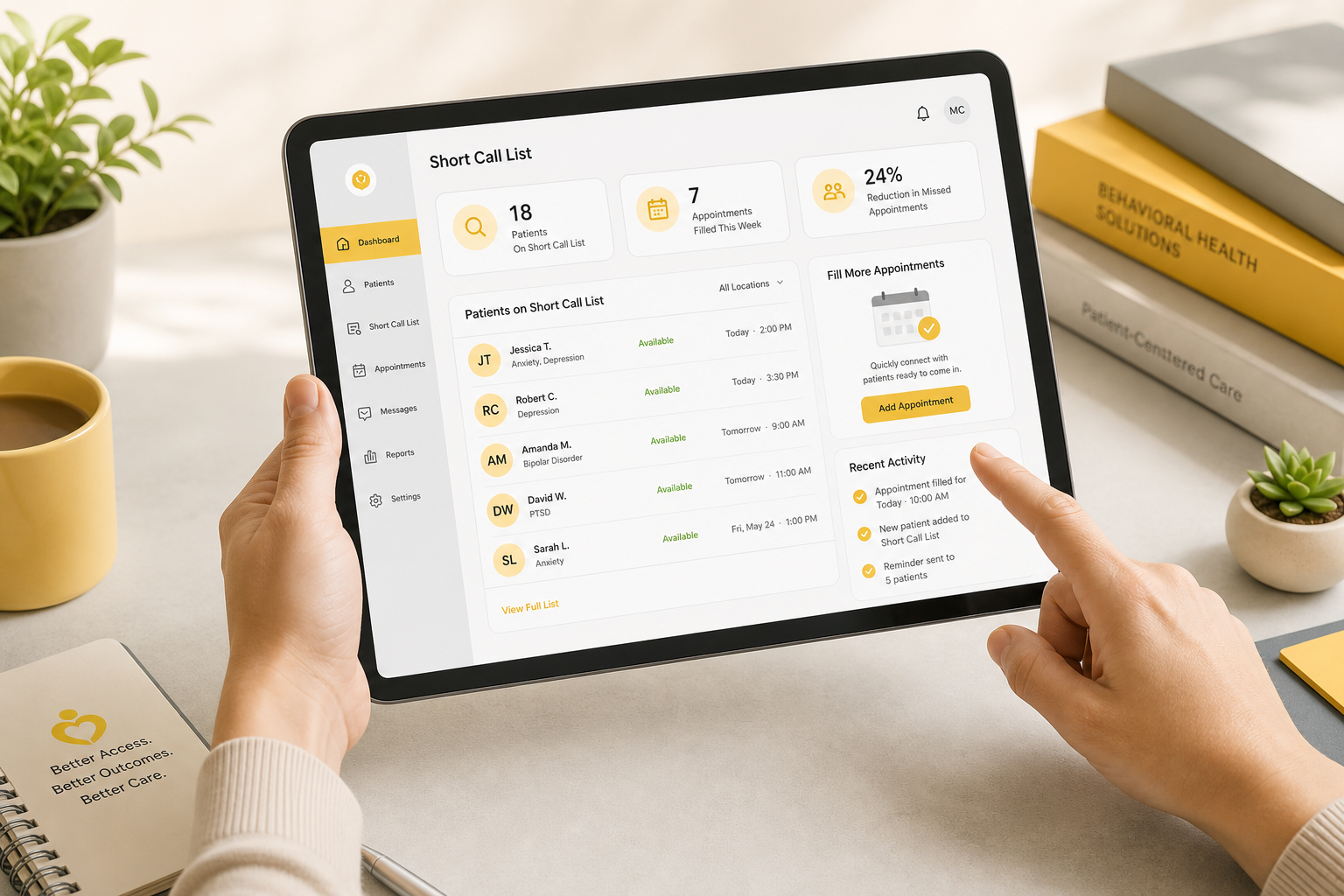
When a behavioral health patient is ready to accept care, timing matters. A cancelled appointment may be the first opening they have seen in weeks, and a slow or impersonal response can feel like another barrier. Short call list management software gives practices a more organized way to offer earlier appointments without asking front-desk teams to chase lists, make repeated calls, or expose sensitive scheduling details. It also helps patients experience a practice that responds quickly, respects privacy, and makes access feel more attainable.
Short Call List Management Software Turns Cancellations Into Earlier Care
Behavioral health schedules change for understandable reasons: a patient may have a work conflict, transportation issue, family emergency, or simply be unable to attend on a difficult day. Each cancellation creates an opening, but filling it manually is often inconsistent. Staff may be handling check-ins, insurance questions, incoming calls, and provider requests at the same time.
Short call list management software helps practices maintain an organized list of patients who want an earlier appointment. When an opening becomes available, the practice can notify appropriate patients based on its scheduling rules rather than relying on whoever happens to be available to make calls.
Patients get a practical path to sooner appointments
For a patient waiting for an intake, medication follow-up, therapy session, or care-plan review, an earlier opening can matter. A well-managed short-call process gives patients a clear option: remain in the scheduled slot or accept an earlier time when one becomes available.
That is different from asking patients to call repeatedly to check for cancellations. Patients should not have to compete for access by being the first person to reach the front desk. A structured process creates a more predictable experience and reduces the frustration of unanswered calls or missed opportunities.
Staff can respond without disclosing unnecessary details
In behavioral health, appointment communications require care. Patients may share phones with family members, avoid detailed voicemail messages, or prefer specific communication channels. Short call list management software should support communication practices that keep messages brief, appropriate, and aligned with patient preferences.
The goal is to offer an available appointment without explaining why an opening exists or revealing information about another patient. That approach protects confidentiality while still giving patients timely access to care.
Short Call List Management Software Reduces the Waiting That Patients Notice
Patients do not see the internal scheduling work behind an appointment calendar. They see how long it takes to receive a response, whether an earlier visit is offered fairly, and whether the practice follows through after they express interest in being seen sooner.
Short call list management software can reduce the manual gaps that cause openings to go unused. Instead of a cancellation sitting on the schedule until someone has time to work down a handwritten list or spreadsheet, staff have a repeatable process for identifying and contacting eligible patients.
Fewer missed opportunities can mean fewer missed appointments
Missed appointments are not always a sign that a patient is disengaged. A patient may have accepted a date weeks in advance because it was the only option, then encountered a conflict before the visit. An earlier appointment that better fits the patient's actual circumstances may be easier to keep.
Practices can use short-call workflows to offer newly available slots to patients who have indicated flexibility. When a patient can choose a time that works sooner, the appointment may feel more immediate and manageable. This does not eliminate no-shows, but it addresses one common cause: a long wait between scheduling and care.
A responsive process reduces uncertainty
Behavioral health patients may already be navigating anxiety, depression, substance-use concerns, family stress, or uncertainty about starting treatment. They should not also be left wondering whether the practice received their request for an earlier appointment.
A defined process gives staff a way to acknowledge and act on patient interest without making promises they cannot keep. Patients receive timely offers when appointments open. Staff retain control over eligibility, provider preferences, appointment types, and the order in which opportunities are presented.
Short-call workflows require an accurate underlying schedule. In production, staff still need clear rules for which visit types can move, which providers accept short-notice appointments, how long an opening remains available, and what happens when a patient does not respond. Technology can organize and automate communication, but it cannot correct unclear scheduling policies. Practices that define these decisions before launch avoid confusion for both staff and patients.
Behavioral Health Scheduling Requires More Than a Generic Waitlist
A behavioral health short-call list accounts for patients who may need continuity with a specific therapist, psychiatrist, counselor, or care team. Some visits require longer time blocks. Others may need to occur by telehealth, in person, or under specific clinical and payer requirements.
That is why short call list management software should fit the practice's actual scheduling rules rather than force staff into a one-size-fits-all process. The right workflow accounts for the realities of behavioral health care while keeping the patient experience straightforward.
Provider continuity should remain visible
An earlier appointment is useful only if it is clinically appropriate. A patient who has built trust with a particular provider may not want to be moved to another schedule just because an earlier slot exists. Staff need the ability to apply the practice's preferences for continuity, appointment type, and provider availability.
For some patients, an earlier visit with another qualified clinician may be welcome. For others, the appropriate choice is to keep the existing appointment. A thoughtful workflow makes room for both outcomes without treating speed as the only measure of success.
Privacy settings are part of patient experience
Privacy shapes whether patients feel safe communicating with a practice. DoctorConnect is HIPAA compliant, signs a BAA with every practice, and hosts PHI in U.S. data centers on SOC 2 Type II audited infrastructure under a BAA with the hosting provider.
Practices should also decide what appointment messages can say, which channels patients have authorized, and how staff will handle replies. A simple, privacy-conscious notification protects sensitive information while giving patients a direct way to respond to an opening.
Better Operations Are Felt by Patients, Not Just Measured by Staff
Practice administrators often evaluate scheduling processes through filled slots, staff time, and cancellation rates. Those measures matter. But patients experience the outcome in more personal terms: "They got back to me." "I was able to get in sooner." "They did not make me explain my situation repeatedly."
DoctorConnect supports more than 500 active medical practices and integrates with more than 150 EHR and practice management systems. For behavioral health organizations, that experience matters because scheduling communication should work within the practice's existing operations rather than become another disconnected task for staff to manage.
A disciplined short-call process can help teams use openings more effectively while giving patients an access experience that feels respectful and responsive. It also gives administrators a clearer operational picture: which appointment types open most often, how quickly openings are offered, and where scheduling rules may need adjustment.
Earlier Access Should Feel Organized, Private, and Reliable
Patients seeking behavioral health care may be taking a difficult first step. A responsive scheduling process cannot solve every access challenge, but it can remove avoidable friction after a patient has decided to seek help. Short-call workflows help practices turn cancellations into timely opportunities, reduce avoidable waiting, and communicate without unnecessary exposure of sensitive information. For staff, that means less manual chasing. For patients, it means the practice is better prepared to respond when an earlier appointment becomes possible.
If short call list management software is on your shortlist for this quarter, we'd be glad to show you how it works in practice .