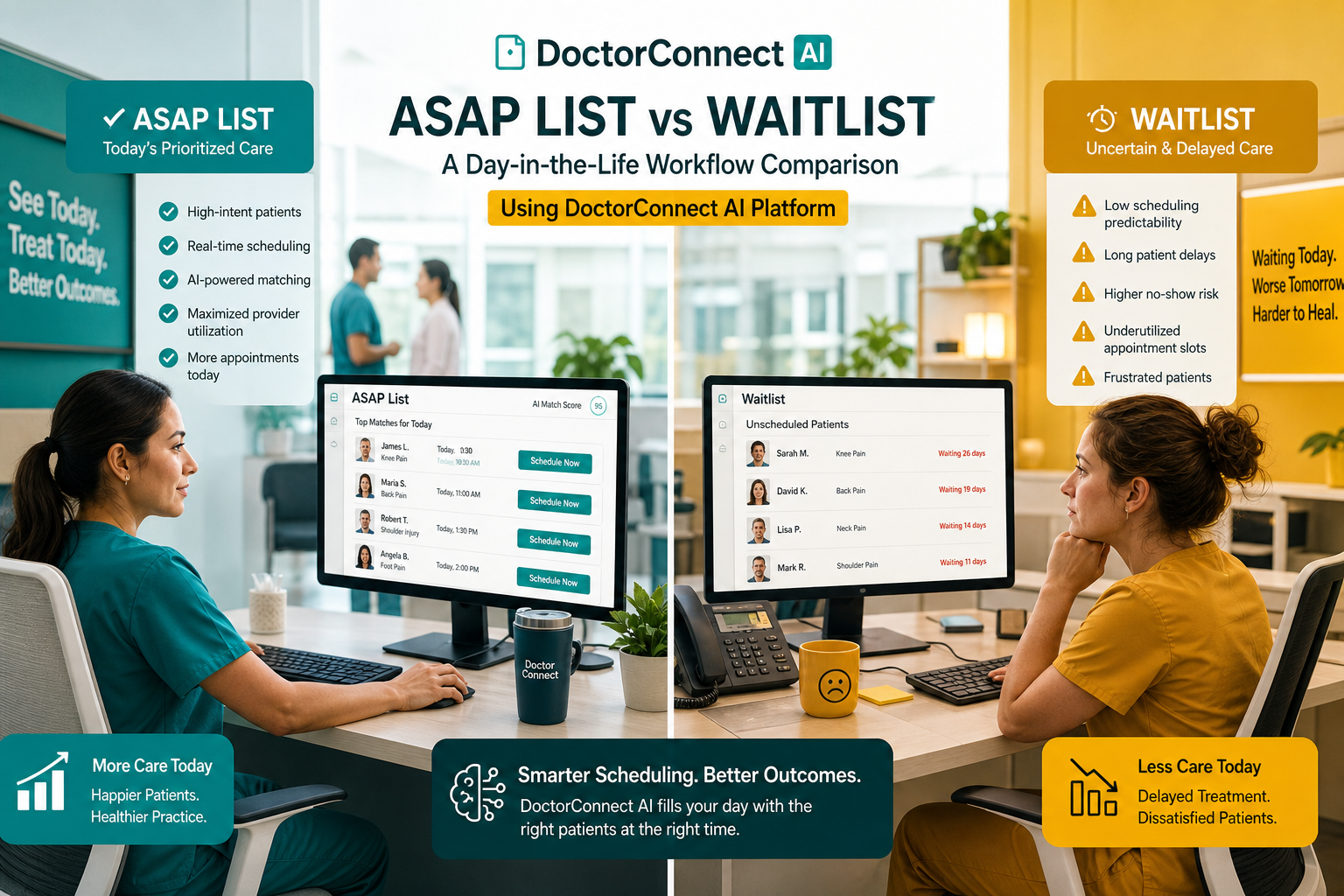
A full primary care schedule can change direction before the first patient arrives. A same-day cancellation, an urgent request, a provider running behind, or a newly available procedure slot each requires a different response from the front desk. The ASAP list vs waitlist medical practice decision is therefore not just a naming choice. It determines who gets contacted, how quickly staff must act, which appointments can be moved, and whether an opening becomes recovered capacity or remains unused. A clear workflow, supported by the DoctorConnect AI Platform, helps practices protect patient access without creating more manual work for staff.
ASAP list vs waitlist medical practice: Two different scheduling jobs
The main distinction is urgency. In an ASAP list vs waitlist medical practice workflow, an ASAP list is built for patients who want or need the earliest available appointment. A waitlist is generally built for patients who already hold a future appointment but would accept an earlier option if one becomes available.
The ASAP list responds to immediate demand
Consider a typical 8:05 a.m. call. A patient needs to be seen promptly for a concern that cannot wait several weeks, but the day appears full. The scheduler adds the patient to an ASAP list with the appropriate appointment type, provider preferences, location, availability, and contact information. The objective is direct. Identify the first clinically appropriate opening and offer it quickly.
For a primary care practice, this list may include patients seeking acute visits, follow-up care after an emergency department visit, medication concerns, or appointments requested after a referral. Staff should not have to search through notes, sticky reminders, and disconnected message queues to remember who asked for the first available slot.
The waitlist improves use of future openings
A waitlist begins with a different patient situation. At 8:20 a.m., a patient accepts an appointment three weeks away but says they would prefer something earlier. That patient has reserved care and is open to moving sooner.
In the ASAP list vs waitlist medical practice comparison, this difference matters because a waitlist can help fill cancellations while protecting the patient's existing appointment. The practice can offer an earlier time without asking staff to rebuild the schedule from scratch if the patient declines or does not respond.
A day-in-the-life workflow: From cancellation to confirmed appointment
At 10:15 a.m., a patient cancels a 2:30 p.m. established-patient visit. This is where scheduling discipline becomes visible. Without a defined process, the opening may sit vacant while staff answer phones, manage check-in, process portal messages, and support clinicians. With a defined process, the opening enters a controlled workflow.
Step 1: Validate the opening before outreach
The scheduler first confirms the visit type, provider, location, and timing. Not every open slot fits every patient. A brief slot may not work for a complex follow-up. A provider-specific appointment may not be suitable for a patient who prefers another clinician. Practices also need to account for instructions such as fasting requirements, referral documentation, interpreter needs, and telehealth eligibility.
This is a practical decision point in the ASAP list vs waitlist medical practice workflow. If the practice needs to place someone who has no suitable future appointment, staff should review the ASAP list first. If the goal is to pull an already scheduled patient forward and preserve access, the waitlist may be the better source of candidates.
Step 2: Contact the right patients in a consistent order
The DoctorConnect AI Platform helps practices organize patient engagement workflows rather than depend on staff memory alone. With the practice's scheduling and patient information connected through its existing systems, staff can use defined criteria to guide outreach and reduce repetitive manual steps.
For an ASAP list, outreach should prioritize patients based on the practice's own rules: clinical appropriateness, urgency indicators, requested provider, availability, and the time since the request was made. For a waitlist, the priority may be patients who have already accepted a later appointment and can reasonably move into the newly open time.
The operational objective is to offer a relevant opening to the patients most likely to accept it, while avoiding confusion, duplicate outreach, or appointments that do not fit the clinical need.
Implementation reality: The bottleneck is usually not the cancellation
Most practices notice cancellations. The difficulty is deciding what should happen next while the schedule continues moving. Front-desk teams may be managing arrivals, insurance questions, refill requests, inbound calls, and provider messages at the same time. If the cancellation workflow depends on one person remembering which patients asked for an earlier appointment, opportunities will be missed during the busiest parts of the day.
That is why the ASAP list vs waitlist medical practice choice should be documented as an operational policy, not treated as an informal preference. Staff need clear answers to basic questions: Which appointment types qualify? Who can be contacted? How long should the practice wait for a response? What happens if a patient accepts an earlier slot? When should the original appointment be released? Who handles exceptions?
DoctorConnect has served healthcare practices since 2009, and automation works best when the practice has first defined the rules it wants automation to follow. Technology can coordinate outreach, support repeatable communication, and help staff act faster. It cannot resolve unclear scheduling ownership or inconsistent appointment standards on its own.
Choosing the right model for patient flow and resource use
Many practices need both lists because they solve separate capacity problems. An ASAP list supports patients seeking the earliest clinically appropriate care. A waitlist supports patients who already have a future appointment but are flexible enough to move sooner. Combining both into one unstructured list can create unnecessary staff review and make it harder to prioritize correctly.
Use an ASAP list when access is the priority
An ASAP list is often the stronger option when the practice receives more near-term appointment requests than the schedule can immediately accommodate. It creates a visible queue for patients who need the earliest suitable opportunity, particularly when same-day or near-term availability appears unpredictably.
For primary care practices, this can improve response to demand created by seasonal illness, post-discharge follow-up needs, chronic-care concerns, and sudden provider schedule changes. The key measurement is whether patients seeking prompt care are being placed efficiently when appropriate openings become available.
Use a waitlist when schedule recovery is the priority
A waitlist is particularly useful when a practice has future demand on the books but loses capacity through cancellations. It gives staff a structured way to offer earlier appointments to patients who have already committed to a later visit. That can reduce unused appointment time while giving patients a more convenient date.
Practices should monitor accepted offers, declined offers, response times, released appointments, and the number of openings that remain unfilled. These operational measures show whether the workflow is helping patient throughput or creating more outreach activity.
Build a workflow staff can run every day
The right answer is usually a clear division of responsibilities between the two. Establish eligibility rules, define which list receives priority for each type of opening, set outreach timing expectations, and make ownership visible. The DoctorConnect AI Platform can support that structure across patient engagement workflows, with more than 150 EHR and practice-management integrations available to help practices connect outreach to the systems staff already use.
For a primary care physician and the administrative team supporting the practice, this means fewer missed opportunities to place patients, less manual schedule chasing, and more reliable use of provider time. A scheduling process earns trust when staff can follow it under pressure and patients receive timely, relevant communication.
DoctorConnect has supported medical practices with ASAP list and waitlist workflows since 2009. Talk to our team about your specific workflow.