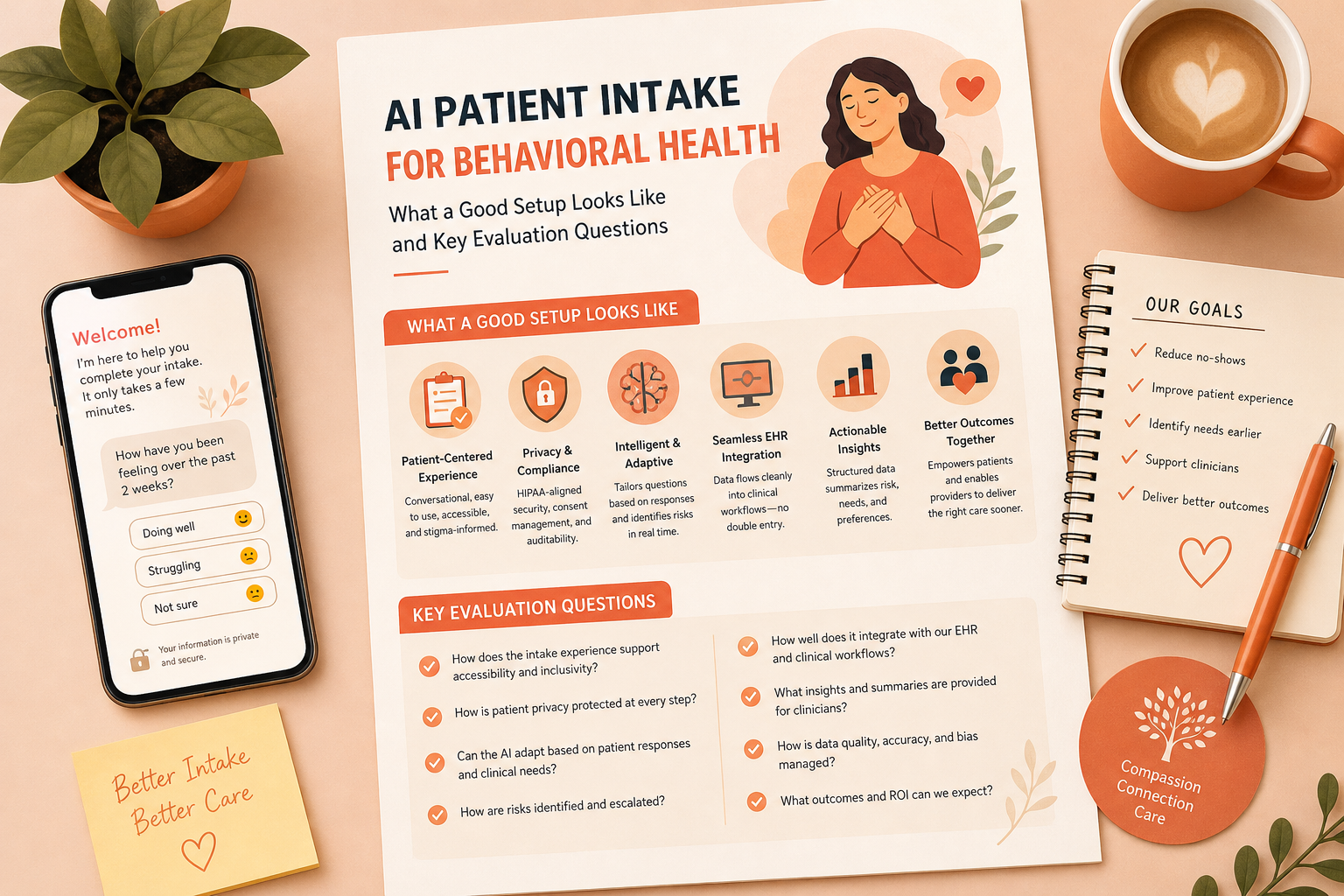
Behavioral health intake is different from a routine primary care visit, and most practices know it the moment a new patient calls to schedule. Questions about trauma history, substance use, or prior hospitalizations do not belong on a clipboard in a waiting room, but they also cannot be skipped or rushed through a front-desk script. This is where AI patient intake has started to change the process for mental health and behavioral health providers. Done well, it can reduce the awkwardness of sensitive disclosures, cut no-shows tied to incomplete paperwork, and give clinicians a cleaner clinical picture before the first session starts. Done poorly, it can feel invasive, generic, or worse, non-compliant. This post walks through what a well-built AI patient intake setup looks like for behavioral health and the questions practices should ask before they sign anything.
What Good AI Patient Intake Looks Like in a Behavioral Health Setting
A well-implemented AI patient intake process for behavioral health removes friction from the administrative and informational steps before clinical judgment begins. The patient completes history forms, consent documents, and screening instruments (PHQ-9, GAD-7, AUDIT, and similar validated tools) on their own time, in their own space, before the appointment. The data flows into the chart in structured form rather than as a scanned PDF someone has to transcribe.
Pacing and Tone Matter as Much as Accuracy
Behavioral health intake forms need to be sequenced thoughtfully. A patient disclosing suicidal ideation or active substance use should not encounter that question wedged between insurance fields and a request for emergency contact information. Good AI patient intake systems allow practices to control branching logic and question order so sensitive material is framed appropriately, with built-in escalation paths, for example, flagging a high-risk screening score for same-day clinical review rather than letting it sit in a queue.
Multi-Channel Delivery Without Multiple Logins
Patients should be able to start intake from a text message, an email link, or a patient portal without creating a separate account for each channel. DoctorConnect's platform sends intake through SMS and email and syncs completion status back to the schedule automatically, so front-desk staff can see at a glance who's finished, who's started, and who needs a reminder without manually calling each person down a list.
Key Features Behavioral Health Practices Should Expect
Not every AI patient intake tool on the market was built with mental health workflows in mind. Some were adapted from general medical intake products with the same consent language and screening logic applied across specialties. For behavioral health, a few features matter more than they do elsewhere.
- Configurable screening instruments that match the validated tools a practice already uses, rather than generic symptom checklists.
- Granular consent workflows that separate general treatment consent from consent for telehealth, release of information, and minor/guardian consent where applicable.
- Risk-flagging logic that routes certain responses to a human reviewer immediately, rather than waiting for the next business-day chart review.
- Integration with the practice's EHR so intake data lands in the correct fields instead of requiring manual re-entry. DoctorConnect currently supports 150+ EHR and practice management integrations, which matters for behavioral health practices often running specialty-specific EHR platforms.
Documentation That Holds Up
Every completed form, timestamped consent, and screening result should be retrievable later. Behavioral health documentation standards around informed consent and risk assessment are unforgiving in an audit or a legal review, and intake records are often the first thing requested.
Implementation: practices that roll out AI patient intake without piloting it on a subset of new patients tend to hit the same snag. A screening tool gets triggered for every patient regardless of presenting concern, front-desk staff get flooded with "high risk" flags that are routine, and within two weeks someone turns off the alert out of fatigue. The fix is to calibrate thresholds during a short pilot period with real patient volume before going practice-wide. Vendors who push a full rollout on day one, with no adjustment period, set practices up for alert fatigue rather than better triage.
Evaluation Questions to Ask Before Choosing a Vendor
Most AI patient intake vendors will answer general questions well. The questions that reveal how a system performs in behavioral health settings are more specific.
Compliance and Data Handling
- Does the vendor sign a Business Associate Agreement, and is PHI hosted in U.S. data centers on infrastructure that has undergone independent security auditing?
- What is the vendor's documented compliance history, and for how long have they operated in healthcare specifically? DoctorConnect has served healthcare practices since 2009 with zero HIPAA violations in that time.
- Can consent and screening documentation be exported in a format that satisfies record retention and audit requests?
Clinical Workflow Fit
- Can screening instruments and question order be customized per patient type (new, returning, adolescent, group therapy intake)?
- What happens operationally when a patient flags high risk during intake, who is notified, and how fast?
- Does the system integrate with the practice's existing EHR, or will staff be re-entering data by hand?
Patient Experience
- Can patients complete intake on a phone without downloading an app?
- Is the language and reading level appropriate for the practice's patient population, including non-English speakers where relevant?
- What completion rate can the vendor show from comparable behavioral health practices?
Avoiding the Common Pitfalls
The practices that struggle most with AI patient intake usually made one of two mistakes: they chose a generic intake tool and tried to force behavioral health workflows into it, or they over-automated sensitive judgment calls that should stay with clinical staff. A sound AI patient intake setup automates the repetitive, administrative layer, scheduling, forms, consent capture, and reminders, while keeping risk assessment, triage decisions, and clinical interpretation firmly in human hands. The technology gets accurate information to the right person faster. Clinical staff make the clinical call.
Behavioral health intake carries more weight than most administrative processes in a practice, and the vendor evaluation should reflect that. A system that handles scheduling well but mishandles a consent form or buries a risk flag can create liability. Practices that ask pointed questions up front, pilot before scaling, and insist on documentation that holds up later tend to see the real benefit: fewer no-shows, cleaner charts, and clinicians who walk into the first session already informed.
If AI Patient Intake for Behavioral Health: What a Good Setup Looks Like and Key Evaluation Questions is on your shortlist for this quarter, we'd be glad to show you how it works in practice .