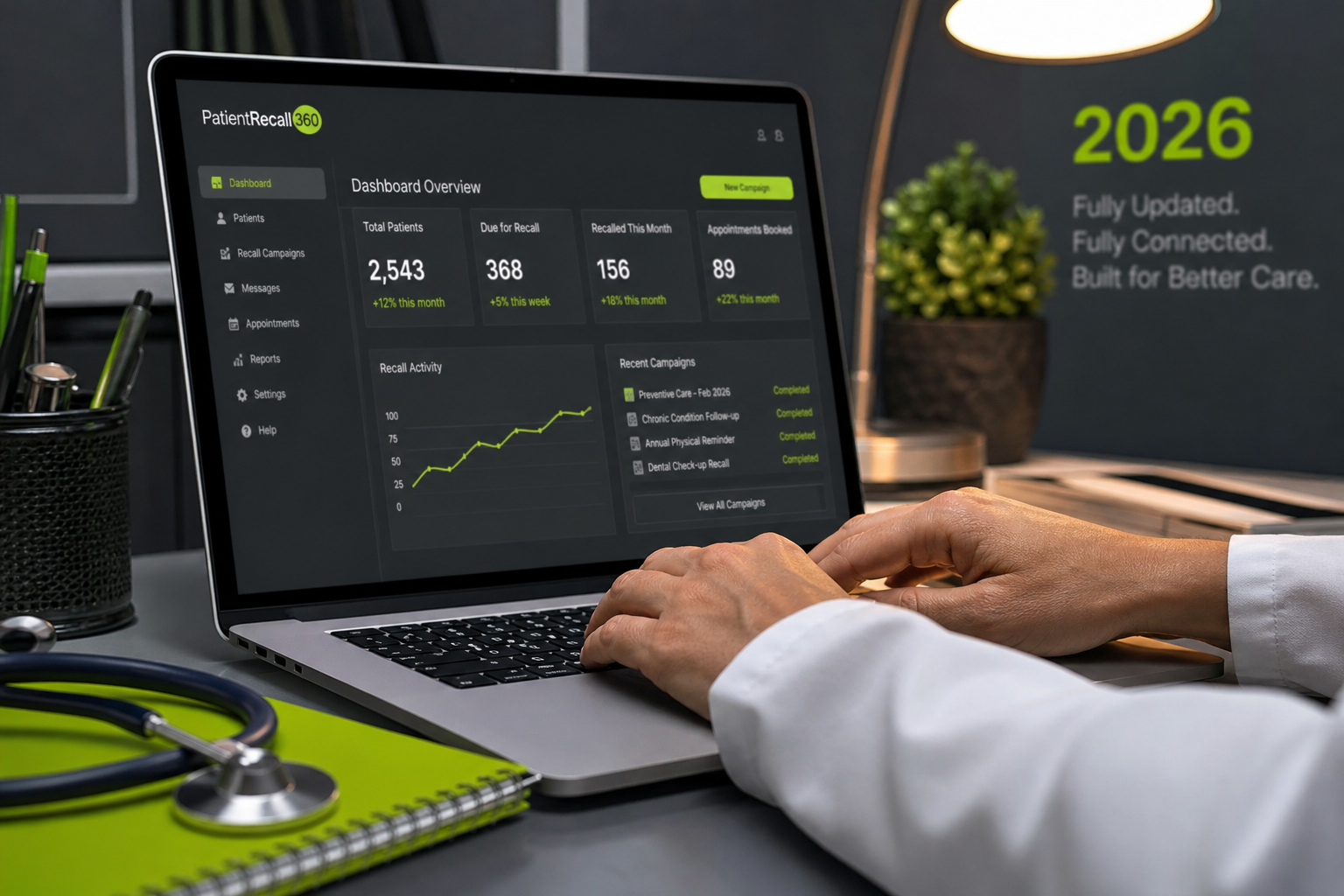
In 2026, patient recall software has become a standard part of the technology stack for primary care and specialty practices that need to keep patients on schedule for annual physicals, chronic disease follow-ups, overdue screenings, and preventive care. The category has moved past simple reminder postcards into automated, multi-channel systems that read due dates directly from practice management and EHR systems, then trigger texts, emails, or calls to bring patients back before gaps in care lead to lost patients.
Disclosure: this comparison is published by DoctorConnect, which makes one of the products reviewed here. Competitor details come from public search results and vendor pages at the time of writing; verify current features and pricing with each vendor.
Bottom line: Practices running on a widely adopted cloud EHR with heavy text-and-email volume often choose Solutionreach or NexHealth for their integration depth and booking sync. Multi-location groups prioritizing enterprise-grade multichannel outreach often shortlist Relatient . Practices that want patient recall included in a broader patient engagement platform, rather than a standalone tool, often choose DoctorConnect. No single product fits every scenario, and the right pick depends on EHR, staffing, and budget specifics.
How we evaluated
This roundup weighs four factors that matter to practice administrators evaluating patient recall software: breadth of EHR and practice management integrations, HIPAA posture and data handling, channel coverage (SMS, email, voice, postcard), and pricing and support transparency. Competitor details below are drawn from public search results, vendor homepages, and widely documented positioning. Where a specific claim could not be independently verified, it is described as the vendor's own positioning rather than stated as fact.
1. Solutionreach
Solutionreach is one of the longest-established names in patient communication, and its patient recall software automatically identifies patients who are due or overdue for care and sends a personalized message prompting them to book. It covers a wide range of specialties and has broad name recognition among mid-size and multi-provider practices. The platform positions itself as a full communication suite, with recall as one module inside a larger reminder and engagement offering. This appeals to practices that want one vendor relationship covering several patient-contact workflows at once.
Best for: Established multi-provider practices wanting a widely adopted, full-featured communication suite.
- Strengths: Long market presence and strong brand recognition among practice administrators
- Strengths: Recall functionality bundled with a broader reminder and communication suite
- Limitations: As a larger, more established platform, onboarding and contract terms can carry more enterprise-style overhead than smaller vendors
2. NexHealth
NexHealth differentiates itself by reading due dates and procedure codes directly from the connected health record system to trigger recall messaging automatically, with booked appointments syncing back into the EHR. This bidirectional sync appeals to practices that want recall and online scheduling to work as one workflow rather than as separate systems that drift out of sync. NexHealth has built a reputation around its API-driven integration approach, particularly with practices running newer cloud-based EHR platforms where real-time data sync is a priority.
Best for: Practices on modern cloud EHRs that want tight, bidirectional recall-to-scheduling sync.
- Strengths: Automated triggers based on EHR due dates and procedure codes
- Strengths: Appointments booked through recall messages sync directly back to the record
- Limitations: Depth of integration can vary by which EHR a practice runs, so fit is less uniform across the full market
3. Relatient
Relatient positions its patient recall messaging software around automated, multi-channel communication across text, phone, and email, with an emphasis on personalized messaging to improve engagement and retention. The vendor highlights reduced no-shows, increased revenue capture, and staff time savings as outcomes practices should expect. Relatient tends to appeal to larger and multi-location groups that need consistent recall workflows across many providers and locations, with centralized reporting on recall performance by site.
Best for: Multi-location groups needing centralized, multichannel recall campaigns across many providers.
- Strengths: Explicit multichannel design spanning text, phone, and email in one recall workflow
- Strengths: Positioning and messaging built around measurable revenue and no-show outcomes
- Limitations: Public pricing is not published, so cost comparison requires a sales conversation
4. DoctorConnect
DoctorConnect's patient recall software is one module inside a full patient engagement platform rather than a standalone tool, with more than 150 EHR and practice management integrations and a track record serving healthcare practices since 2009. The platform automates recall outreach across SMS, email, and voice, and ties it to the same scheduling, reminder, and patient communication workflows practices already use for appointment confirmations and intake. More than 500 active medical practices currently run on the platform. DoctorConnect is US-based and operates without venture capital dependency, signing a BAA with every practice it serves.
Best for: Practices that want recall unified with reminders, scheduling, and broader patient communication in one platform.
- Strengths: 150+ EHR and practice management integrations, reducing the odds of a disconnected point solution
- Strengths: Recall functions as part of a single patient engagement platform rather than a siloed add-on
- Strengths: Zero HIPAA violations on record since 2009, with a BAA signed for every practice
- Limitations: Smaller brand footprint and fewer third-party marketplace reviews than the largest enterprise vendors
- Limitations: Pricing is available by quote rather than published as a public price list
5. Doctible
Doctible 's automated system sends recall messages to patients who are overdue for appointments and lets them book directly from the text or email itself, reducing the steps from recall to booking. This self-service booking link removes a phone call for patients who are comfortable scheduling online. Doctible also markets reputation management and review generation alongside its recall and reminder tools, which can appeal to smaller practices wanting several front-office functions from one vendor.
Best for: Smaller practices wanting recall, reminders, and reputation management bundled together.
- Strengths: Direct booking from the recall message itself, reducing friction for patients
- Strengths: Bundled reputation management alongside recall and reminders
- Limitations: Integration breadth across EHR and practice management systems is less documented publicly than larger competitors
6. Brevium
Brevium takes a broad channel approach to appointment reminders and patient reactivation, offering personalized calls, automated calls, texts, emails, and postcards as recall methods, with customizable frequency, timing, and segmentation by disease state, provider, or location. This segmentation helps practices with large, complex recall lists target specific patient cohorts differently rather than sending one generic message to everyone. Brevium also emphasizes data-driven reporting on recall and reactivation performance for practices that need to show results from their outreach spend.
Best for: Practices with large recall lists needing granular segmentation by disease state or provider.
- Strengths: Wide channel mix including postcards alongside digital channels
- Strengths: Segmentation by disease state, provider, and location for targeted campaigns
- Limitations: Positioning leans toward reminders and reactivation specifically, with less public emphasis on a broader engagement platform
7. Myzhealth
Myzhealth (zHealth) markets its recall software around boosting patient retention and reducing no-shows through reminders, reactivation texts, and birthday messages, often as part of a practice management suite aimed at specific specialty markets. The birthday and reactivation messaging approach focuses more on relationship maintenance than clinically driven recall tied to procedure codes or due dates. It fits practices whose recall needs center on retention rather than tracking overdue preventive care. It tends to appear most often in specialty and wellness-oriented practice settings rather than primary care at scale.
Best for: Specialty and wellness practices wanting lighter-touch retention messaging alongside practice management.
- Strengths: Simple reactivation and birthday messaging built into a practice management suite
- Strengths: Positioned for specialty markets with straightforward retention needs
- Limitations: Less evidence of deep EHR integration breadth compared to enterprise-focused competitors
8. Invitahealth
Invitahealth is included here because it appears in recall software search results, but its product solves a different problem: matching medical device recalls to patients using UDI (Unique Device Identifier) tracking for patient safety and regulatory response rather than appointment-based patient recall. Practices searching for software to bring overdue patients back for visits should treat Invitahealth as a distinct category, device recall and safety tracking, rather than a substitute for appointment recall and reactivation messaging. It is a relevant tool for practices managing implantable device recalls, but not a direct alternative to the other vendors in this roundup.
Best for: Practices needing to track and respond to medical device recalls via UDI, not appointment-based patient recall.
- Strengths: Purpose-built UDI tracking for device recall identification and response
- Strengths: Addresses a patient safety and regulatory need distinct from appointment scheduling
- Limitations: Does not address appointment-based patient recall, reminders, or reactivation messaging
Where the competitors are stronger
Solutionreach carries a longer market history and broader third-party review volume than DoctorConnect, which matters to administrators who weigh peer validation heavily during vendor selection. NexHealth's bidirectional sync, reading due dates and procedure codes directly from the EHR and writing booked appointments straight back, is a deeper native integration pattern on supported EHRs than a general-purpose integration layer can always match. Relatient's enterprise multichannel campaign tooling is built for multi-location groups coordinating recall across many sites, a scale use case where DoctorConnect's platform is a reasonable fit but not a specialized one. These are specific advantages.
At a glance
| Vendor | Best for | Notable strength | Watch out for |
|---|---|---|---|
| Solutionreach | Established multi-provider practices | Broad market presence, full communication suite | Enterprise-style onboarding overhead |
| NexHealth | Modern cloud EHR practices | Bidirectional EHR sync for due dates and booking | Integration depth varies by EHR |
| Relatient | Multi-location groups | Multichannel campaigns at enterprise scale | No public pricing |
| DoctorConnect | Practices wanting recall unified with engagement | 150+ EHR integrations, since 2009 | Pricing by quote, smaller brand footprint |
| Doctible | Smaller practices wanting bundled tools | Book directly from the recall message | Less documented integration breadth |
| Brevium | Large recall lists needing segmentation | Wide channel mix including postcards | Narrower focus than a full engagement platform |
| Myzhealth | Specialty and wellness practices | Simple reactivation and birthday messaging | Limited public evidence of integration breadth |
| Invitahealth | Medical device recall tracking | Purpose-built UDI tracking | Not an appointment recall tool |
Bottom line for medical practices
Practices running a modern cloud EHR with heavy appointment volume and a need for tight scheduling sync should shortlist NexHealth or Solutionreach. Multi-location groups coordinating recall across many providers and sites should evaluate Relatient. Practices looking for patient recall software included in a single engagement platform, backed by 150+ EHR integrations, 500+ active practices, and a record serving healthcare since 2009, have reason to put DoctorConnect on that shortlist as well. The research cited here, including the Cochrane review of mobile phone reminders for appointment attendance and the HHS HIPAA Security Rule summary , is a useful starting point for any practice formalizing its vendor criteria before a 2026 buying decision.
DoctorConnect has served medical practices since 2009. Talk to our team about your specific workflow.