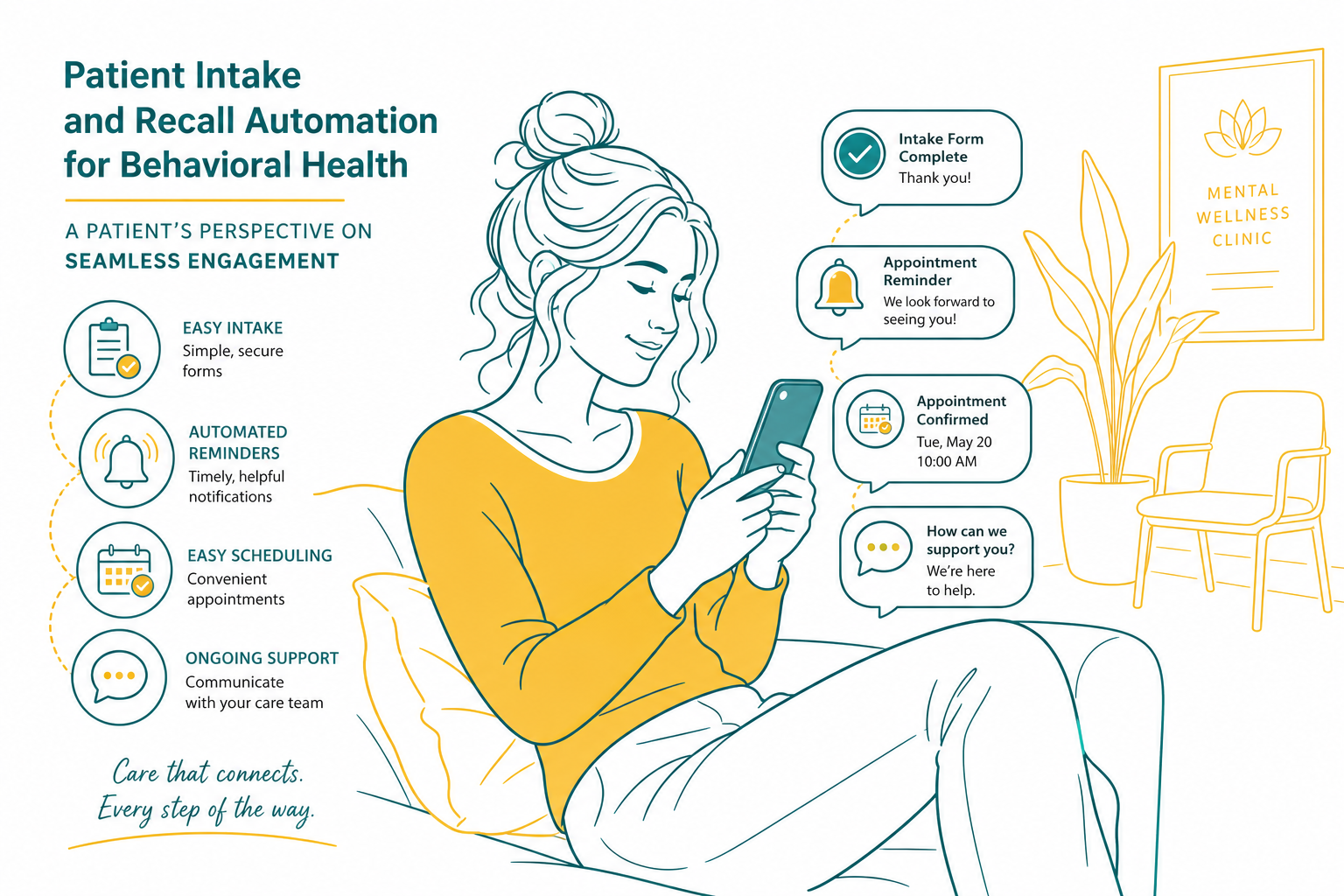
In 2026, patient intake and recall automation software has moved from a nice-to-have add-on to a baseline expectation at behavioral health practices, because clients increasingly judge a practice's privacy and convenience by how smoothly a system handles their first intake form and every reminder or recall message that follows. For a population that often weighs confidentiality more heavily than the general medical population, the gap between a clunky portal and a quiet, well-timed text message can be the difference between a client who stays in treatment and one who quietly disappears after intake.
Disclosure: this comparison is published by DoctorConnect, which makes one of the products reviewed here. Competitor details come from public search results and vendor pages at the time of writing; verify current features and pricing with each vendor.
No single platform in this roundup is right for every behavioral health group. Practices that need deep EHR integration across a large, multi-location group and a long compliance track record will want to shortlist DoctorConnect and Calvient. Practices whose core pain point is specifically overdue or lapsed patients, rather than full intake workflow, should give Brevium a close look. Practices already running a broader CRM for marketing across multiple service lines may find LeadSquared's automation workflows a reasonable fit if healthcare-specific nuance is not the top priority.
Why patient intake and recall automation software matters for behavioral health practices
Behavioral health intake is different from a typical primary care visit. A new client is often disclosing trauma history, medication history, or family information they have never written down before, and they are doing it before they have met the clinician face to face. Patient intake and recall automation software lets clients complete sensitive forms privately from home instead of on a clipboard in a waiting room. It standardizes follow-up and recall messages, so a missed appointment does not trigger an alarming or clinically inappropriate text. It also gives front-desk staff a documented, repeatable process for reaching clients who go quiet between sessions, a risk point in behavioral health continuity of care.
The HHS Office for Civil Rights guidance on patient privacy states that any system touching protected health information, including appointment and recall messages, has to meet the same confidentiality standard regardless of channel. The HIPAA Security Rule summary lays out the administrative, physical, and technical safeguards that any vendor handling this data must support. For behavioral health specifically, recall automation has to be configurable enough to avoid disclosing diagnosis or service type in a text or voicemail, something general-purpose reminder tools do not always default to.
How we evaluated the field
This roundup weighs each platform against four criteria that matter most to behavioral health operations: breadth of EHR and practice management integration, documented HIPAA posture, coverage across SMS, email, and voice channels, and transparency of pricing and support model. Competitor details come from each vendor's public homepage and the search snippet that surfaces for this keyword; where a claim could not be independently verified, it is described as the vendor's own positioning rather than as settled fact.
1. DoctorConnect
DoctorConnect is a full patient engagement platform covering intake forms, appointment reminders, recall campaigns, and two-way messaging in one system. It has served healthcare organizations since 2009 and currently supports more than 500 active medical practices with over 150 EHR and practice management integrations, which matters for behavioral health groups that run a mix of scheduling and billing systems across locations. The platform is HIPAA compliant, signs a BAA with every practice, and is hosted on Microsoft Azure's SOC 2 Type II infrastructure, giving practices a documented compliance chain for audits or payer credentialing reviews.
Best for: multi-location behavioral health groups that need one platform to span intake, reminders, and recall across varied EHRs.
- Strengths: broad EHR integration footprint built over more than a decade of healthcare-specific deployment
- Strengths: a single platform covering intake, reminders, and recall rather than three separate point tools
- Strengths: zero HIPAA violations on record since 2009, a data point for practices answering compliance questionnaires
- Limitations: smaller public brand footprint and fewer third-party marketplace reviews than the largest enterprise CRM players
- Limitations: pricing is available by quote rather than published on a public price list, which slows early-stage comparison shopping
2. Calvient
Calvient positions itself around automating patient communication across the full lifecycle, including reminders, recall, surveys, no-show recovery, and follow-up workflows. Its site describes visibility into every handoff from intake forward. This workflow-first design can appeal to behavioral health practices that want granular control over how a client moves from first contact through ongoing care coordination. As a newer entrant to the patient communication space compared to the legacy recall vendors in this list, Calvient's public documentation focuses more on workflow automation than on an extensive list of EHR integrations or a long-dated compliance track record.
Best for: practices that want highly configurable, workflow-level automation spanning intake through no-show recovery.
- Strengths: explicit coverage of the full communication lifecycle in its own positioning, including no-show recovery as a named workflow
- Strengths: visibility into handoffs, which behavioral health care coordination workflows depend on
- Limitations: less public detail available on EHR integration breadth and years of healthcare-specific deployment compared to longer-established vendors on this list
3. Brevium
Brevium is built specifically around patient reactivation, using what it describes as a proprietary, data-science-powered platform to identify a practice's highest-value overdue patients and automate their return. For a behavioral health practice whose main operational pain is a growing list of clients who disengaged mid-treatment, that narrow focus can be an advantage. The product focuses on solving one problem rather than spanning intake, scheduling, and marketing. It is less positioned as a front-door intake tool and more as a recall and reactivation layer that typically sits alongside an existing scheduling or EHR system.
Best for: practices whose primary pain point is reactivating a backlog of overdue or lapsed patients rather than redesigning intake.
- Strengths: a scoring approach specifically built to rank overdue patients by value, a recall-specific capability the vendor markets as proprietary
- Strengths: a tightly scoped product that is easier to evaluate against a single use case
- Limitations: narrower scope than a full intake and engagement platform, so practices may still need separate tools for forms and ongoing reminders
4. zHealth
zHealth markets its Patient Plus module as a way to automatically reactivate patients and bring them back to the practice, framed as part of a broader practice management suite. zHealth's public positioning and market presence center on chiropractic and similar outpatient specialties rather than behavioral health specifically, so a behavioral health group evaluating it would want to confirm directly with the vendor how its intake forms, consent language, and recall messaging can be adapted to the confidentiality requirements of mental health and substance use treatment records before committing.
Best for: practices already invested in zHealth's broader practice management suite who want reactivation built into that same system.
- Strengths: reactivation functionality bundled with a broader practice management platform rather than sold as a standalone add-on
- Limitations: public positioning and market presence center on specialties outside behavioral health, so fit for mental health intake and confidentiality needs should be confirmed directly with the vendor
- Limitations: less publicly documented behavioral-health-specific configuration than platforms built around that use case
5. LeadSquared
LeadSquared is a broader marketing and sales automation platform that has built patient engagement features on top of its general CRM architecture, including automated workflows for appointment reminders, feedback collection, and marketing campaigns. That heritage makes it a flexible option for healthcare organizations that already use LeadSquared for lead management across multiple lines of business, but the platform was not purpose-built around the confidentiality and clinical-workflow needs of behavioral health intake in the way the other entries in this roundup were. Practices considering it should evaluate how its HIPAA posture and consent handling are configured for mental health use specifically, rather than assuming general healthcare configuration is sufficient.
Best for: organizations already standardized on LeadSquared's CRM for marketing automation across service lines, including behavioral health.
- Strengths: workflow automation across reminders, feedback, and marketing in one general-purpose platform
- Strengths: flexibility to extend the same automation logic beyond patient engagement into broader marketing use cases
- Limitations: general CRM design rather than a healthcare-first build, so behavioral-health-specific privacy configuration needs direct vendor confirmation
Where the competitors are stronger
Brevium's product uses a named, proprietary scoring approach to identify which overdue patients to prioritize for reactivation, a data-science capability that DoctorConnect's platform does not publicly document as a distinct, separately branded module. A practice whose single biggest operational problem is a long list of lapsed clients, and that wants a tool built narrowly around solving that problem with a documented scoring methodology, may evaluate Brevium ahead of a broader engagement platform. Separately, LeadSquared's general-purpose CRM architecture gives it workflow flexibility across marketing, sales, and patient engagement simultaneously, which a healthcare-specific platform is not designed to replicate.
At a glance
| Vendor | Best for | Notable strength | Watch out for |
|---|---|---|---|
| DoctorConnect | Multi-location groups needing one platform across intake, reminders, and recall | 150+ EHR integrations and healthcare deployment since 2009 | Pricing available by quote only |
| Calvient | Granular, workflow-level automation from intake through no-show recovery | Explicit coverage of the full communication lifecycle | Less public detail on EHR integration breadth |
| Brevium | Reactivating a backlog of overdue or lapsed patients | Proprietary overdue-patient scoring model | Narrower scope than a full intake platform |
| zHealth | Practices already using zHealth's broader practice management suite | Reactivation bundled into an existing suite | Market presence centers on specialties outside behavioral health |
| LeadSquared | Organizations standardized on a general CRM across service lines | Wide workflow automation across marketing and engagement | Not purpose-built for behavioral health confidentiality needs |
Bottom line for behavioral health practices
Practices evaluating patient intake and recall automation software for a multi-location behavioral health group with varied EHRs should shortlist DoctorConnect for its integration breadth and long-standing HIPAA compliance record. Practices whose core need is workflow granularity across the full client lifecycle should look closely at Calvient, while those whose single biggest problem is a backlog of disengaged clients should evaluate Brevium's reactivation-specific scoring approach. zHealth and LeadSquared primarily suit organizations already invested in their broader suites.
We've refined patient intake and recall automation software for behavioral health across 500+ practices since 2009. Get in touch to see which version fits your practice.