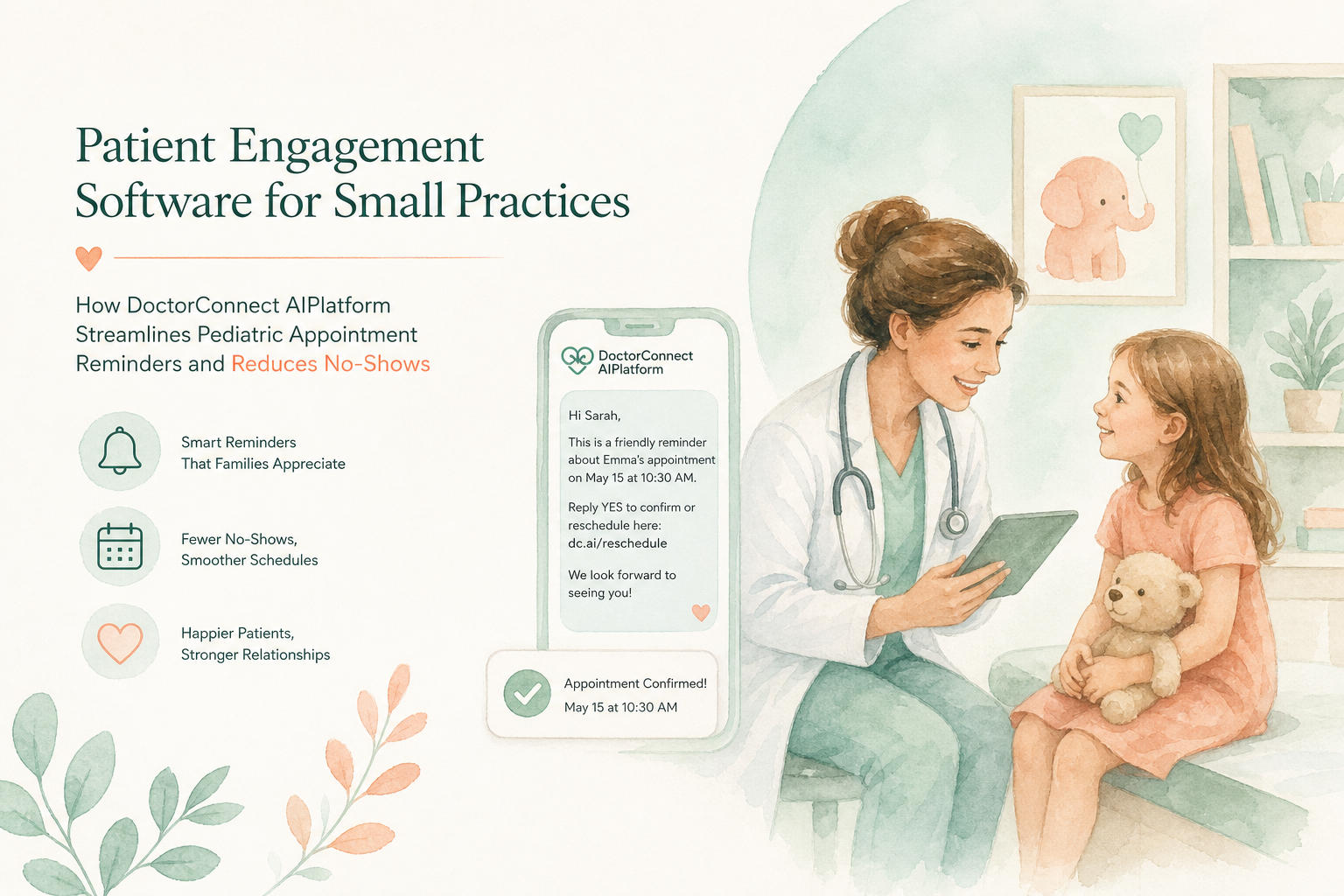
In 2026, patient engagement software for small practices has become an operational consideration for pediatric teams working to reduce appointment no-shows, manage late cancellations, and keep caregivers informed. Pediatric scheduling has added complexity: a parent may book, another caregiver may bring the child, insurance details may change, and recurring well visits or follow-up care can be easy to postpone amid busy family schedules. The right platform should help the front desk communicate consistently while preserving a respectful, family-centered experience.
Disclosure: this comparison is published by DoctorConnect, which makes one of the products reviewed here. Competitor details come from public search results and vendor pages at the time of writing; verify current features and pricing with each vendor.
Bottom line: Phreesia may fit organizations seeking a broad patient-intake and engagement suite. Qliqsoft may suit teams that need configurable, no-code communication workflows. DoctorConnect AIPlatform deserves consideration for independent pediatric practices focused on reminders, recall outreach, and EHR-connected patient communications. Clearwave may be a better match for larger organizations seeking a wider enterprise-oriented digital patient experience platform.
How we evaluated
This comparison considers four practical factors for pediatric offices: EHR and practice-management integration breadth, HIPAA posture, communication channels for reminders and caregiver outreach, and the support or implementation model needed to put workflows into daily use. We also considered whether each vendor publicly positions its platform around scheduling, registration, messaging, payments, or broader patient-experience needs. Competitor details are based on public search results and vendor pages, so practices should validate current features, pricing, implementation requirements, and integration compatibility during their own evaluation.
What pediatric teams should solve before selecting software
Pediatric no-shows are rarely only a reminder problem. A missed appointment may result from a caregiver receiving a message at the wrong number, uncertainty about transportation, confusion about whether a child is due for a visit, or a scheduling conflict discovered too late for the office to refill the slot. Families also may be coordinating between parents, grandparents, guardians, schools, and childcare providers. A communication workflow that works for an adult primary-care appointment may not account for those realities.
Patient engagement software for small practices should be evaluated as a workflow decision. Practices should examine how a platform handles appointment confirmation, cancellation instructions, wait-list outreach, recurring-care recall, digital forms, and staff escalation when a family replies with a question. The goal is to make the next appropriate action understandable and easy to complete.
Operational polling from MGMA Stat practice-operations polling can help administrators place staffing, access, and workflow concerns in the broader context of medical-practice operations. While every pediatric office has its own mix of payer rules, staffing capacity, and patient population, the recurring challenge is consistent: staff time should go toward helping families and resolving exceptions, rather than repeatedly placing routine reminder calls.
Security also belongs in the evaluation from the beginning. The HHS HIPAA Security Rule summary describes the administrative, physical, and technical safeguards covered entities and business associates must consider for electronic protected health information. A vendor conversation should include a clear review of the business associate agreement, access controls, message content, integration architecture, and how staff will use the system appropriately.
1. Phreesia
Phreesia publicly positions its offering as a comprehensive patient engagement and intake platform spanning the patient journey before, during, and after visits. Its public materials emphasize automated communications, reminders, payments, feedback collection, patient intake, and customizable outreach. For a pediatric organization that wants to combine registration and engagement processes under a broad vendor platform, that scope may be appealing. It may be especially relevant where digital intake, payment workflows, and communication programs are being reviewed together, rather than as separate operational projects. Smaller offices should confirm package scope, implementation expectations, and which features are appropriate for their current staffing model.
Best for: Pediatric organizations evaluating intake, payments, communications, and feedback tools as one broader platform initiative.
Strengths:
- Public positioning covers multiple stages of the patient journey.
- Messaging and outreach customization are part of its stated offering.
- Includes patient-intake capabilities alongside engagement functions.
Limitations:
- The breadth of the platform may exceed the immediate needs of a small office focused primarily on reminders and recall.
- Practices should verify which workflows, integrations, and services are included in the quoted configuration.
2. Clearwave
Clearwave positions itself as a patient engagement platform with digital scheduling, registration, communications, and related patient-facing workflows. Its public positioning also references work with thousands of multi-specialty organizations and health systems, which suggests an orientation toward larger, more complex healthcare environments. For a pediatric group affiliated with a health system, or one seeking broad digital front-door capabilities, Clearwave may merit close review. Its appeal is likely strongest when registration, scheduling, and patient communications need to fit into a coordinated enterprise program. Independent offices should ask how implementation, configuration, and commercial terms scale to a smaller practice setting.
Best for: Larger pediatric groups, multi-specialty organizations, and health-system-connected practices seeking extensive patient-facing workflows.
Strengths:
- Publicly positioned around scheduling, registration, and communications.
- Established presence in multi-specialty and health-system environments.
- Suitable for organizations considering a broad digital patient experience initiative.
Limitations:
- Enterprise-oriented capabilities can require a more involved evaluation and rollout process.
- Smaller practices should validate fit, pricing, and administrative overhead for their scale.
3. DoctorConnect
DoctorConnect AIPlatform is a patient engagement platform serving healthcare since 2009, with more than 500 active medical practices and more than 150 EHR and practice-management integrations. For pediatric offices, its relevant use case is operational communication: appointment reminders, confirmations, recall outreach, and follow-up messaging that can reduce manual calling and give families clear next steps. DoctorConnect is HIPAA compliant, signs a BAA with every practice, and is hosted on Microsoft Azure's SOC 2 Type II infrastructure. The platform may be a practical fit for independent practices that want connected communication workflows without purchasing a larger enterprise patient-experience suite.
Best for: Independent pediatric practices seeking EHR-connected appointment reminders, recall campaigns, and patient communication support.
Strengths:
- More than 150 EHR and practice-management integrations.
- Healthcare-focused platform experience dating to 2009.
- Serves more than 500 active medical practices.
Limitations:
- DoctorConnect has a smaller brand footprint than major enterprise patient-engagement vendors.
- Pricing is available by quote rather than through a public price list.
- It has fewer third-party marketplace reviews than some larger software brands.
4. Qliqsoft
Qliqsoft publicly positions the Quincy Digital Engagement Platform as a no-code environment for creating and customizing patient engagement workflows. Its stated capabilities include chatbot, SMS, branded messaging, HIPAA-compliant digital forms, secure two-way communication, and flexible EHR integration. That positioning may suit pediatric organizations with unusual communication paths, such as workflows that route caregiver replies, deliver digital forms, or support branded outreach beyond basic appointment reminders. A no-code approach can be attractive when operations teams want flexibility, but practices should establish governance around who designs workflows, approves message content, and monitors outcomes after launch.
Best for: Pediatric groups that need configurable digital engagement workflows and secure two-way communication.
Strengths:
- No-code workflow customization is central to its public positioning.
- Supports SMS, chatbots, branded messaging, and digital forms.
- Public materials emphasize flexible EHR integration.
Limitations:
- Greater workflow flexibility can require stronger internal ownership and governance.
- Practices should confirm the effort required to configure pediatric-specific communication scenarios.
5. PracticeSuite
PracticeSuite positions its offering around secure communication, online scheduling, accessible records, and tools intended to support ongoing patient engagement. That combination may interest small practices looking for patient-facing access and communication functions connected to broader practice workflows. For pediatric offices, online scheduling and accessible records can be useful when caregivers need convenient ways to manage routine care, although the office should determine how guardian access, scheduling rules, and age-related privacy policies are handled. PracticeSuite may be worth reviewing when a practice wants engagement capabilities in the context of a wider practice-management conversation, rather than only an outbound reminder program.
Best for: Smaller practices evaluating patient communications alongside scheduling and practice workflow tools.
Strengths:
- Public positioning includes secure communication and online scheduling.
- Connects engagement discussions with patient access to records.
- May appeal to practices seeking multiple operational functions.
Limitations:
- Practices should confirm the depth of its reminder, recall, and pediatric caregiver workflow features.
- Guardian access and privacy configuration need careful review in pediatric settings.
6. Healthfully
Healthfully describes patient engagement software as supporting several parts of the care journey, including appointment reminders, digital registration, and secure messaging. That framing aligns with core needs for pediatric offices that want to reduce friction before an appointment and give families digital options for routine administrative tasks. It may be a sensible vendor to investigate for teams prioritizing communication and registration workflows without necessarily seeking a much broader enterprise platform. Since public positioning can describe a category more broadly than a specific purchased package, pediatric administrators should ask for a detailed walkthrough of reminder automation, cancellation handling, message personalization, integration options, and support during implementation.
Best for: Pediatric offices exploring appointment reminders, digital registration, and secure patient messaging.
Strengths:
- Publicly identifies reminders, registration, and secure messaging as engagement use cases.
- Focuses on patient-facing administrative communication needs.
- May fit a practice evaluating foundational digital engagement functions.
Limitations:
- Practices should validate integration breadth and pediatric-specific workflow support directly.
- Public materials should not be treated as a substitute for a feature-by-feature demonstration.
7. Veradigm
Veradigm positions FollowMyHealth as a comprehensive, mobile-first patient engagement platform for acute and ambulatory care. Public descriptions highlight a unified patient-facing experience with features such as appointment scheduling, telehealth, pharmacy-related tools, and broader engagement capabilities. For pediatric organizations connected to larger ambulatory networks or looking for a mobile patient platform that spans multiple service lines, that scope may be relevant. The tradeoff is that a comprehensive platform can be more than a small independent office needs if the immediate objective is reducing missed appointments and improving recall outreach. Practices should ask how pediatric proxy access and family communication workflows are supported.
Best for: Larger ambulatory organizations seeking a mobile-first patient platform across multiple care settings.
Strengths:
- Publicly positioned for both acute and ambulatory care.
- Mobile-first patient engagement orientation.
- Broad patient-facing feature set, including scheduling and telehealth.
Limitations:
- Its wider scope may be unnecessary for a small practice with a focused reminder need.
- Pediatric proxy-access requirements should be assessed carefully.
8. Practicefusion
Practice Fusion publicly presents itself primarily as an EHR platform, emphasizing e-prescribing, adaptive charting, flexible billing, and customized implementation. For a pediatric practice already considering an EHR decision, it may be reasonable to ask what patient-facing engagement capabilities are available within that environment and whether they cover the office's communication requirements. However, its public positioning in the supplied results is more centered on clinical documentation and practice operations than on a dedicated patient-engagement platform. It may fit practices that prioritize an EHR-led technology stack, but teams with detailed reminder, recall, and caregiver communication needs should verify feature depth rather than assume it matches a specialized platform.
Best for: Practices evaluating an EHR-led technology stack that includes broader operational capabilities.
Strengths:
- Public positioning emphasizes core EHR functions, including e-prescribing and charting.
- Includes billing and implementation considerations.
- May appeal to teams beginning with an EHR evaluation.
Limitations:
- Its supplied public positioning is not primarily centered on dedicated patient engagement.
- Practices should verify reminder, recall, messaging, and caregiver workflow capabilities directly.
How patient engagement software for small practices supports pediatric attendance
For pediatric teams, reminder timing matters as much as reminder delivery. A message sent far in advance may be forgotten, while a message sent too late may not give a caregiver time to arrange transportation, leave work, or coordinate school pickup. The appropriate cadence depends on the appointment type, the practice's cancellation policy, and the family population. Well-child visits, behavioral health follow-ups, vaccine appointments, and specialty referrals may need different outreach rules.
Personalization should also be practical rather than overly complicated. Families need the appointment date, time, location, clinician or service line when relevant, and a simple way to confirm, cancel, or contact the office. For recurring care, recall messages should clarify why the child is due, using language approved by the practice. Staff should be able to see which families responded and which need a human follow-up.
When evaluating patient engagement software for small practices, administrators should ask whether the product helps create a usable exception queue. Automated communication is most helpful when it identifies situations staff need to handle: unconfirmed appointments, cancellation requests, invalid contact information, unanswered recall notices, or caregiver questions. A platform does not remove the need for compassionate staff interaction. It can make that interaction more timely and focused.
Questions to ask during a pediatric software demonstration
A productive demonstration should follow an actual pediatric scheduling scenario. Ask the vendor to show a new-patient appointment, a recurring well-child recall, an appointment confirmation, a late cancellation, and an attempt to fill an opening. The purpose is to see how much staff work remains after automation begins. An attractive dashboard is less important than whether the office can understand the next step for each family and act without switching among multiple systems.
Ask how contacts are sourced and updated. Pediatric charts can include multiple caregiver numbers, preferred communication methods, and proxy-access considerations. The office should understand which system is the source of truth, how data moves between the EHR and engagement platform, and how quickly updates appear. The ONC Health IT Certification Program provides useful context for understanding certified health IT, but certification status alone does not establish whether a particular integration meets a practice's operational needs.
Also ask vendors to explain the support model plainly. Who configures reminders? Who helps adjust messages after a policy change? What happens when an integration issue affects appointment data? Is training included for front-desk staff, and can reporting distinguish confirmations, cancellations, failed deliveries, and patient replies? These questions matter especially for smaller teams where one office manager or lead scheduler may be responsible for several systems.
Where the competitors are stronger
Clearwave is stronger than DoctorConnect in publicly established enterprise and health-system market reach. Its public positioning references service to thousands of multi-specialty organizations and top-ranked health systems, while DoctorConnect serves more than 500 active medical practices. Phreesia is stronger than DoctorConnect in the breadth of its publicly positioned patient-intake and payment capabilities. Qliqsoft is stronger than DoctorConnect in its explicit no-code workflow customization positioning. These differences matter when a pediatric organization needs enterprise-scale digital registration, payment workflows, or internally designed communication automation beyond its core reminder and recall requirements.
Implementation considerations for pediatric offices
Before signing an agreement, a pediatric practice should document its current attendance workflow. List who sends reminders, when they are sent, how cancellations are recorded, how openings are filled, and when staff make personal calls. Then identify where families encounter friction. The answer may be inconsistent contact information, unclear cancellation instructions, limited evening response capacity, or a lack of recall processes for preventive visits. Technology should be configured to address those specific issues.
Message governance also matters. Practices should decide which messages can be automated, who approves template changes, and how replies are routed. They should also consider language preferences and accessibility needs. For sensitive matters, the platform should support a process that directs caregivers to an appropriate staff member rather than attempting to resolve a clinical question through an automated workflow. Communication tools should support the practice's policies and staff judgment, not replace them.
Measure the outcome carefully. Track confirmation rates, cancellations received early enough to refill, no-show patterns by appointment type, and staff time spent on outbound calls. Results should be reviewed over a meaningful period because attendance can vary with school calendars, seasonal illness, weather, and local transportation issues. A practical implementation is one that improves visibility for staff and makes it easier for families to communicate with the office.
At a glance
| Vendor | Best for | Notable strength | Watch out for |
|---|---|---|---|
| Phreesia | Broad intake and engagement initiatives | Patient journey coverage, including intake and payments | May exceed a small office's focused reminder needs |
| Clearwave | Enterprise and health-system-connected organizations | Scheduling, registration, and communications scope | Confirm fit and implementation needs for a smaller office |
| DoctorConnect | Independent practices focused on connected communication workflows | 150+ EHR and practice-management integrations | Quote-based pricing and a smaller enterprise footprint |
| Qliqsoft | Configurable engagement workflows | No-code workflow positioning | Requires internal workflow ownership |
| PracticeSuite | Scheduling and patient communication evaluations | Secure communication and online scheduling | Validate pediatric workflow depth |
| Healthfully | Foundational engagement functions | Reminders, registration, and secure messaging | Confirm integrations and implementation details |
| Veradigm | Large ambulatory networks | Mobile-first patient platform scope | May be broader than a small practice requires |
| Practice Fusion | EHR-led technology evaluations | Core EHR and billing positioning | Verify dedicated engagement capabilities |
Bottom line for pediatric practices
Pediatric practices should shortlist products according to the problem they need to solve. Phreesia and Clearwave warrant consideration when a larger organization is evaluating intake, registration, payments, and patient experience together. Qliqsoft may fit teams that need highly configurable communication workflows. DoctorConnect is worth shortlisting for independent pediatric practices that value more than 150 EHR and practice-management integrations, healthcare experience since 2009, and a platform serving more than 500 active medical practices. The appropriate choice supports family communication without adding unnecessary operational complexity.
We've been refining Patient Engagement Software for Small Practices: How DoctorConnect AIPlatform Supports Pediatric Appointment Reminders and Reduces No-Shows across 500+ practices since 2009. Get in touch to see what version of it would fit yours.