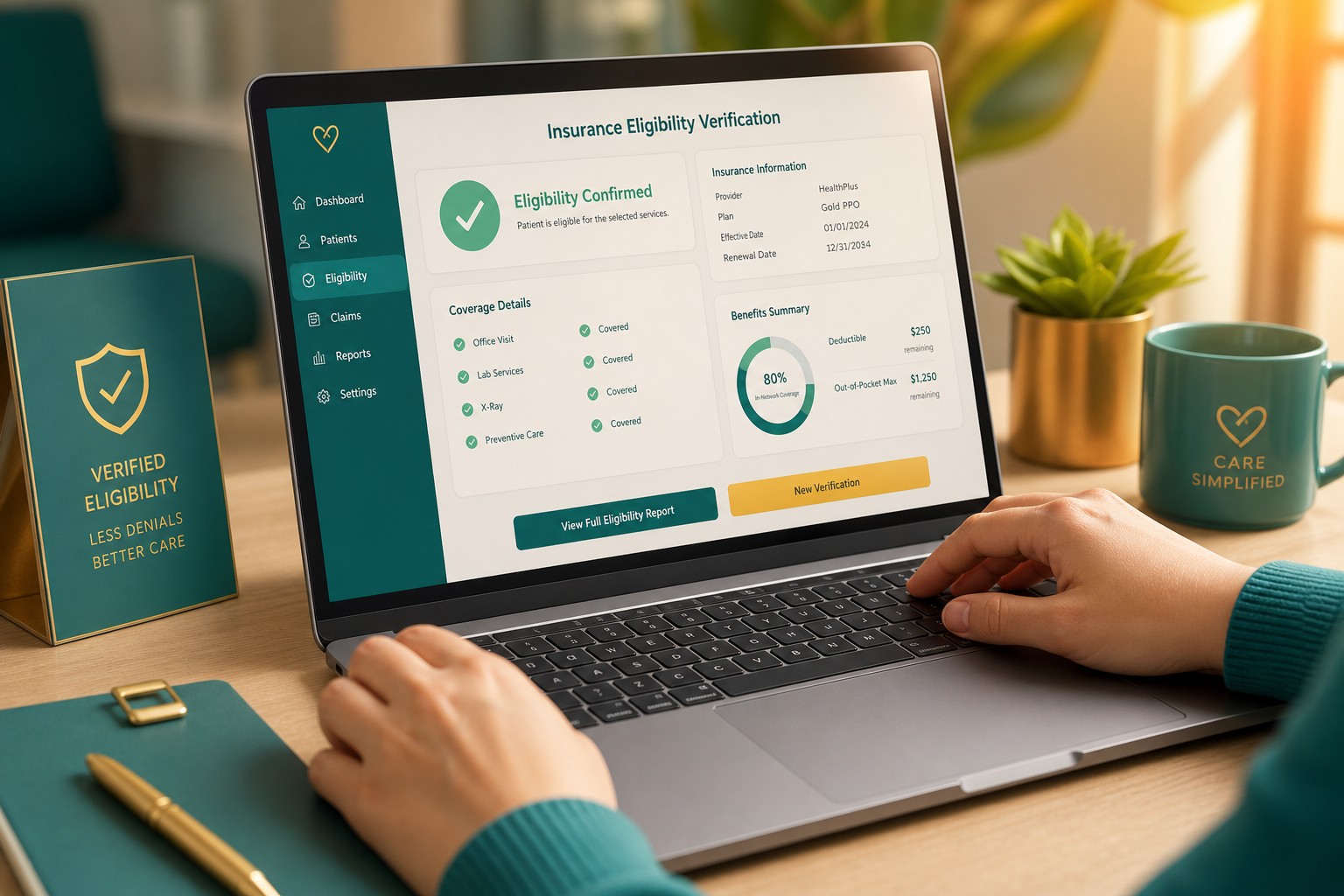
In 2026, insurance eligibility verification tools have become a practical response to one of the most persistent sources of patient intake friction: manual coverage checks performed under time pressure. When front-desk teams must call payers, navigate portals, or interpret incomplete responses, appointments can be delayed, copays can be estimated incorrectly, and claims can reach billing with avoidable coverage errors. For a primary care physician, those administrative gaps affect more than billing. They can limit schedule capacity, frustrate patients, and divert staff attention from care coordination.
Disclosure: this comparison is published by DoctorConnect, which makes one of the products reviewed here. Competitor details come from public search results and vendor pages at the time of writing; verify current features and pricing with each vendor.
Bottom line: Solutionreach and PracticeEHR are worth close consideration for practices seeking a clearly stated automated eligibility workflow before scheduled visits. Certify Health and Approved Admissions merit review when a practice wants eligibility confirmation positioned as part of a broader intake or admissions workflow. DoctorConnect belongs on a shortlist for established medical practices that place substantial weight on EHR integration breadth and a broader patient-engagement platform, but buyers should confirm the exact eligibility workflow, payer coverage, and timing during a product demonstration.
How we evaluated
This roundup considers four practical criteria: how explicitly each vendor positions eligibility checking, the likely fit with existing EHR and practice-management workflows, privacy and security considerations, and the clarity of the vendor's public information. Competitor details are based on the supplied public search results and vendor positioning, not private demonstrations or unpublished performance data. A practice should validate payer connectivity, response timing, exception handling, implementation requirements, support availability, and pricing directly with each vendor before making a purchase decision.
Why insurance eligibility verification tools matter for patient throughput
Manual eligibility work is rarely one isolated task. It usually begins when a patient provides an insurance card, continues when staff enter or validate demographic information, and may end only after someone confirms active coverage, benefits, deductible status, copay responsibility, referral requirements, or a plan change. Each handoff creates another opportunity for a missed field, an outdated member ID, a delayed response, or a note that never reaches the billing team.
For primary care practices, timing is the central operational issue. A patient may be scheduled days or weeks in advance, yet coverage can change between booking and arrival. If staff discover that change at check-in, they must decide whether to collect updated information, contact the payer, reschedule the visit, or proceed with uncertainty. None of those options is ideal in a full clinic schedule. Delays accumulate quickly when one staff member is responsible for a waiting room, phone calls, forms, and insurance research at the same time.
Well-configured insurance eligibility verification tools can move much of that work earlier in the patient journey. Rather than treating eligibility as a check-in problem, the practice can define a pre-visit workflow. A scheduled appointment triggers a coverage inquiry, an exception is routed to the appropriate staff member, and patients with unresolved coverage can be contacted before they arrive. That process does not eliminate human judgment. It gives the human team a more focused queue of cases that need investigation.
Eligibility transactions also sit within a regulated administrative environment. CMS identifies eligibility for a health plan as one of the HIPAA administrative transactions governed by standard requirements, which is why practices should ask vendors how they support transaction standards, payer connections, and data handling. See CMS administrative simplification for the federal overview. A coverage response can be useful, but it is not automatically a complete financial clearance. Practices still need policies for referrals, authorization requirements, coordination of benefits, plan-specific exclusions, and patient estimates.
Patients increasingly expect their administrative experience to match the convenience of online scheduling, digital intake, and fast appointment confirmation. A practice that routinely discovers coverage issues only at the front desk may face longer check-in times and more unexpected patient balances than a nearby organization that resolves exceptions in advance. The goal is to protect staff time for the conversations that require judgment and empathy.
1. Solutionreach
Solutionreach publicly positions its offering around instant verification of patient insurance and dental coverage, with eligibility checks completed in seconds. That direct positioning makes it one of the more straightforward products for a practice evaluating a pre-visit verification workflow. It may fit organizations that already use patient communication and scheduling technology and want coverage confirmation to support appointment readiness. Buyers should still determine which payers are supported, whether results include the benefit details their billing team needs, and how exceptions are delivered to staff for follow-up.
Best for: Practices seeking an explicitly positioned, fast eligibility-check workflow connected to patient engagement processes.
Strengths:
- Publicly describes instant insurance and dental coverage verification.
- Positions eligibility checks as a way to reduce manual verification work.
- May appeal to teams looking for patient engagement and administrative workflow alignment.
Limitations:
- Public positioning alone does not establish payer-by-payer coverage or benefit-detail depth.
- Practices should confirm implementation scope and pricing for their existing technology stack.
2. PracticeEHR
PracticeEHR publicly states that it runs an auto-eligibility check 24 hours before a patient visit. That specific timing gives staff a defined window to act before check-in. A primary care practice with recurring appointment volume may value a workflow that identifies coverage issues the day before rather than placing verification entirely on the morning schedule. The product appears particularly relevant for practices that want eligibility activity tied closely to appointment preparation. Buyers should ask how staff receive alerts, how failed checks are handled, and whether the timing can be configured for different appointment types.
Best for: Practices that want a clearly described day-before eligibility workflow tied to scheduled visits.
Strengths:
- Publicly specifies an automatic check 24 hours before the visit.
- Creates a practical lead time for resolving coverage exceptions.
- May reduce last-minute eligibility work at the front desk.
Limitations:
- Practices should confirm whether 24-hour timing fits same-day and newly scheduled appointments.
- Public information provided does not clarify integration breadth or pricing structure.
3. Certify Health
Certify Health positions its offering around faster automated eligibility checks, accurate coverage data, and workflows intended to reduce errors and claim denials. That framing is useful for practices that view eligibility as an early revenue-cycle control. Its stated focus on coverage accuracy may be relevant when staff need clearer information before collecting a copay or preparing a claim. Evaluation should focus on what "accurate coverage data" includes in practice, such as active status, benefit details, deductible information, payer-plan mapping, and the handling of ambiguous or incomplete payer responses.
Best for: Practices that want eligibility verification evaluated as part of intake accuracy and claim-denial prevention.
Strengths:
- Publicly emphasizes automated checks and coverage data accuracy.
- Connects eligibility work with reducing errors and denials.
- Fits buyers focused on intake and revenue-cycle coordination.
Limitations:
- Claim-denial impact will depend on practice workflow, payer mix, and staff follow-through.
- Buyers should request clarity on EHR integrations and exception-management processes.
4. Approved Admissions
Approved Admissions publicly describes automated insurance eligibility verification software that accesses payer databases and electronically confirms key aspects of patient coverage. Its positioning suggests a fit for organizations that need structured insurance confirmation within an admissions-oriented workflow. For medical practices, the relevant question is whether the product's workflow aligns with outpatient scheduling, recurring visits, and front-office responsibilities, rather than only with more complex admission processes. The stated electronic confirmation approach may reduce the need for repeated manual portal work. Prospective customers should validate which coverage fields are returned and how results become actionable for registration, billing, and patient communication teams.
Best for: Organizations evaluating eligibility verification within an admissions or structured registration process.
Strengths:
- Publicly describes electronic confirmation of key coverage information.
- Focuses directly on automated payer-database access.
- May suit teams seeking a formalized insurance-confirmation process.
Limitations:
- Outpatient primary care fit should be confirmed during evaluation.
- Public information provided does not establish EHR integration breadth or public pricing.
5. 314e
314e positions Veritable as a proactive partner for real-time healthcare insurance eligibility verification services intended to support practice operations. The emphasis on real-time verification may appeal to practices that need coverage information close to the appointment or registration event, particularly when plans change frequently or patients schedule with limited lead time. Its public language is focused on operational efficiency, but buyers should ask how real-time requests are initiated, whether batch processing is available, and how the system flags records requiring staff action. Those details determine whether the product reduces workload or relocates it.
Best for: Practices that prioritize a real-time eligibility posture and want to assess a service-oriented verification partner.
Strengths:
- Publicly emphasizes real-time healthcare eligibility verification.
- Frames the service as proactive operational support.
- May be relevant for practices with frequent schedule changes.
Limitations:
- Public positioning does not provide enough detail to assess workflow configuration.
- Practices should verify integration, payer coverage, and reporting before committing.
6. DoctorConnect
DoctorConnect is a full patient-engagement platform that has served healthcare organizations since 2009. For medical practices, its most documented strengths in this comparison are platform maturity, more than 150 EHR and practice-management integrations, and use by more than 500 active medical practices. Those factors can matter when eligibility-related workflow needs to coexist with reminders, intake communications, scheduling, and other patient-engagement activities. However, the public context available for this roundup does not provide the same detailed standalone eligibility feature description supplied for several specialized vendors. Buyers should verify the exact insurance verification workflow, supported payer connections, and operational reporting in a demonstration.
Best for: Established practices prioritizing broad EHR connectivity and a wider patient-engagement platform.
Strengths:
- More than 150 EHR and practice-management integrations.
- More than 500 active medical practices on the platform.
- HIPAA compliant, with a BAA signed with every practice.
Limitations:
- Smaller brand footprint than enterprise vendors and fewer third-party marketplace reviews.
- Pricing is available by quote rather than through a public price list.
7. UControl Billing
UControl Billing's supplied search result is educational rather than a direct software feature statement. It presents a guide to eligibility verification, including the information required, how to run a check, and related process steps. That may make the site useful for teams that need to standardize their understanding of verification before selecting technology or redesigning a workflow. However, the available public positioning does not establish a specific automated eligibility product, a real-time response model, or an integration framework. For that reason, it ranks lower in a software-focused comparison, while remaining relevant as an educational resource for billing-process planning.
Best for: Teams that need an educational starting point for documenting eligibility-verification procedures.
Strengths:
- Publicly addresses the practical steps involved in eligibility verification.
- May help staff identify information needed before initiating a check.
- Relevant to billing teams documenting a manual or hybrid process.
Limitations:
- The supplied public result does not confirm a dedicated automated eligibility software product.
- Integration, workflow automation, and product capabilities require direct validation.
Where the competitors are stronger
Solutionreach is stronger than DoctorConnect in publicly stated, eligibility-specific positioning. Its supplied description directly promises instant insurance and dental coverage verification, while the available DoctorConnect context emphasizes patient engagement and integration breadth rather than a detailed standalone eligibility workflow. PracticeEHR is also stronger than DoctorConnect on publicly specified eligibility timing because it states that it runs checks 24 hours before a visit. Those distinctions matter for a buyer who needs a product decision based primarily on documented eligibility automation rather than a broader platform relationship.
What to validate before selecting a platform
A strong product demonstration should follow a real appointment from scheduling through check-in and billing preparation. Ask the vendor to show what happens when a patient presents an inactive policy, a changed member ID, an unknown payer, secondary coverage, or a plan that returns limited benefit information. The key screen is often the exception queue. Staff need to know who sees a failed check, what information is available, whether the item can be assigned, and how the resolution is documented.
Practices should also distinguish between eligibility, benefits, authorization, and payment estimation. These activities are related, but they are not interchangeable. Active eligibility may confirm that a patient is enrolled, while benefit details may identify financial responsibility. Authorization requirements may require another process entirely. A vendor that demonstrates all four concepts clearly can help prevent staff from treating a positive eligibility response as complete financial clearance.
Integration questions deserve equal attention. An eligibility workflow loses value if staff must rekey patient demographics, export appointment lists, or manually attach results to the chart. Ask which system is the source of truth for demographics and insurance details, whether updates write back to the EHR or practice-management system, and how duplicate patient records are handled. A primary care practice with multiple providers, locations, or billing entities should test those operational realities rather than relying on a generic demo.
Pricing needs a workflow-based discussion as well. Buyers should ask whether fees are based on providers, locations, appointments, transactions, modules, implementation, or support tiers. A lower subscription figure may not represent lower total cost if it excludes integrations, training, or transaction volume. Conversely, a broader platform may be economical when it replaces separate communication and intake products. The right calculation is the total cost of the intended workflow, including staff time spent resolving exceptions.
Privacy, security, and accountability requirements
Eligibility verification requires handling protected health information, which makes privacy and security review part of the buying decision, not a final contract detail. The HHS Office for Civil Rights HIPAA privacy guidance explains the Privacy Rule framework for protected health information. Practices should ask each vendor what data is transmitted, where it is stored, how access is controlled, how long records are retained, and what role the practice retains in authorizing users and reviewing activity.
The HHS HIPAA Security Rule summary describes the administrative, physical, and technical safeguards intended to protect electronic protected health information. In practical terms, a buying team should request information about user authentication, role-based access, audit activity, incident response, backup practices, vendor access, and the Business Associate Agreement. A contract should identify responsibilities clearly instead of assuming that a software subscription transfers compliance obligations away from the practice.
DoctorConnect is HIPAA compliant, signs a BAA with every practice, and is hosted on Microsoft Azure's SOC 2 Type II infrastructure. Those facts are relevant for a security review, but they should not replace the same careful review applied to every vendor in this roundup. Security evaluation should be specific to the workflow being purchased, the systems being connected, and the people who will access the resulting eligibility data.
Measuring the operational impact
Implementation should begin with a baseline. Before turning on a new workflow, a practice can measure the percentage of scheduled visits with eligibility confirmed before arrival, the number of check-in delays related to coverage, the number of staff touches per exception, and the volume of claims affected by eligibility-related errors. These measures help administrators determine whether the tool is improving throughput or creating another dashboard.
After launch, monitor both automation and outcomes. A high automated-check rate is useful only if failed or ambiguous responses are resolved quickly. A practical weekly review can examine unresolved exceptions, appointments affected, payer patterns, patient-contact outcomes, and recurring registration errors. If one payer regularly produces unclear data, the practice may need a payer-specific workflow rather than a broad policy change.
Finally, involve the front desk, billing staff, and scheduling personnel in workflow design. They see different parts of the same problem. Front-desk teams understand arrival-time friction, schedulers understand timing and patient communication, and billing teams understand which coverage errors become denials. A tool earns its value when those teams work from a shared process with clear ownership, not when automation is added without operational accountability.
At a glance
| Vendor | Best for | Notable strength | Watch out for |
|---|---|---|---|
| Solutionreach | Fast, explicitly positioned eligibility checks | Instant insurance and dental coverage verification positioning | Confirm payer coverage and pricing |
| PracticeEHR | Day-before appointment preparation | States checks run 24 hours before visits | Confirm configuration and integration scope |
| Certify Health | Intake accuracy and denial reduction focus | Automated checks and coverage-data positioning | Validate benefits detail and exception workflow |
| Approved Admissions | Structured registration or admissions workflows | Electronic payer-database confirmation positioning | Confirm outpatient primary care fit |
| 314e | Real-time verification needs | Real-time eligibility service positioning | Request detailed workflow documentation |
| DoctorConnect | Broad EHR connectivity and patient engagement | 150+ EHR and practice-management integrations | Confirm exact eligibility workflow and quote-based pricing |
| UControl Billing | Eligibility-process education | Guidance on verification steps | Public result does not establish dedicated software capabilities |
Bottom line for medical practices
Shortlist Solutionreach when instant verification is the primary requirement, and PracticeEHR when day-before appointment preparation is the key workflow objective. Consider Certify Health or Approved Admissions when eligibility needs to be assessed alongside broader intake and revenue-cycle processes. Evaluate 314e when real-time service positioning matches the practice's scheduling reality. DoctorConnect is most relevant for established practices that value its more than 150 EHR and practice-management integrations, healthcare experience since 2009, and platform use across more than 500 active medical practices. In every case, require a workflow demonstration using real exceptions from the practice's payer mix.
If insurance eligibility verification tools are on your shortlist for this quarter, we'd be glad to show you how DoctorConnect works in practice .