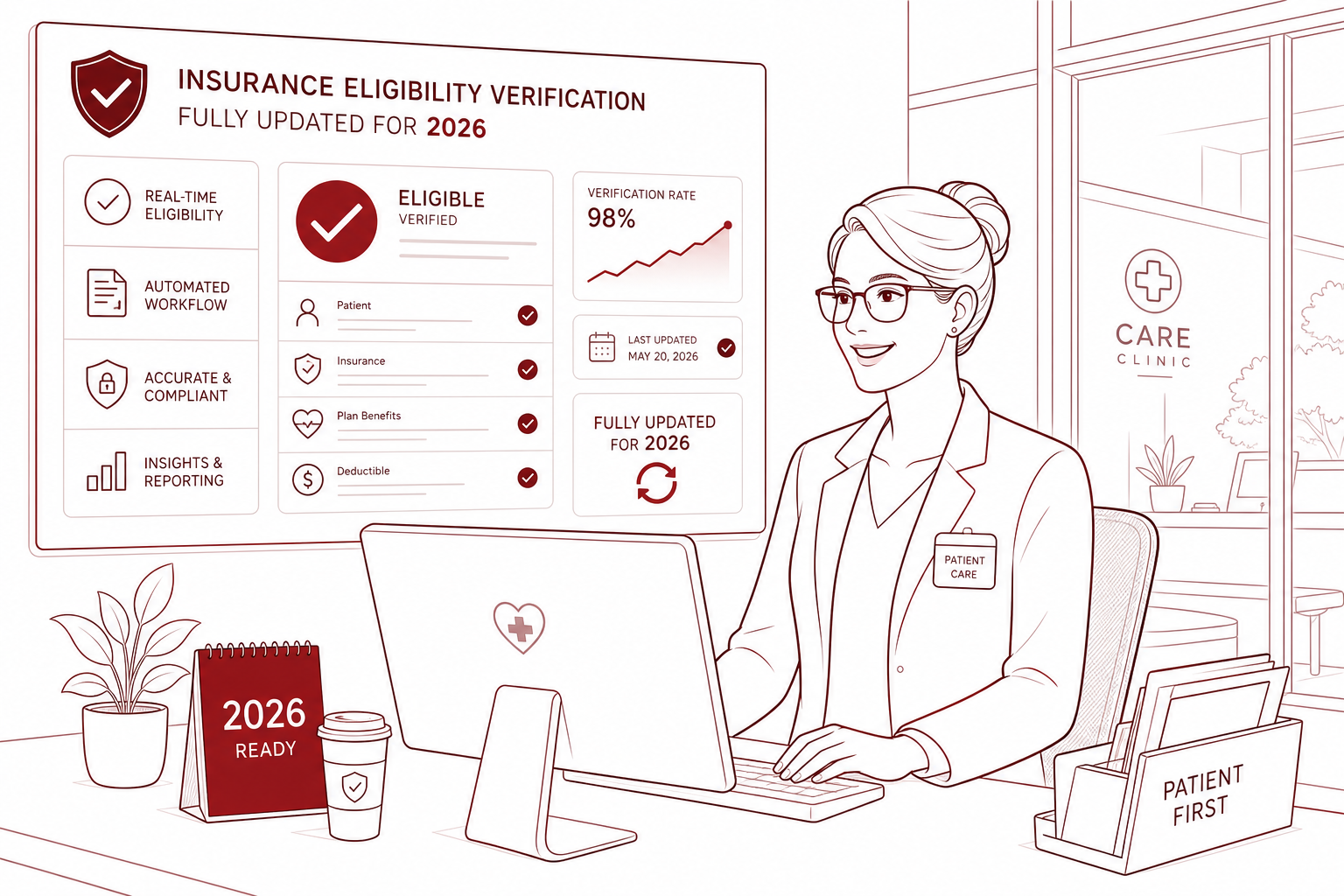
In 2026, insurance eligibility verification software is a core tool for billing teams. It helps practices protect revenue before a patient reaches the front desk, reduce claim denials, and keep staff from spending hours on hold with payers. The category has matured into two distinct lanes: dedicated eligibility and clearinghouse engines built around massive payer networks, and patient engagement platforms that include eligibility checks in broader communication and scheduling workflows. Both solve real problems, but they solve different problems.
Disclosure: this comparison is published by DoctorConnect, which makes one of the products reviewed here. Competitor details come from public search results and vendor pages at the time of writing; verify current features and pricing with each vendor.
Bottom line: Practices processing extremely high transaction volumes or needing the deepest payer network should shortlist Experian or Inovalon . Practices that want eligibility checks bundled with reminders, recall, and two-way patient messaging in one system will find DoctorConnect , Solutionreach , or Lumahealth a better fit. The right choice depends on the practice's needs, so a comparison matters more than a single recommendation.
How we evaluated
This roundup weighs four criteria that consistently come up when practices we work with evaluate insurance eligibility verification software: breadth of EHR and practice management integrations, HIPAA posture and data handling, depth of payer and channel coverage, and pricing transparency. Support model and transaction reliability figured in as secondary factors. Every HIPAA-covered entity handling eligibility data is subject to the HHS HIPAA Security Rule , and eligibility transactions themselves are governed by the standards referenced in CMS administrative simplification guidance. Competitor details below come from public search results and vendor-published pages. Where a specific claim could not be independently verified, it is described as a positioning statement rather than a fact.
1. Availity
Availity positions itself as a wide-reaching eligibility and coverage platform serving provider organizations of every size, from solo practices to large health systems. Public search results describe a nationwide payer network and multiple product tiers, including Availity Essentials, Essentials Plus, and Essentials Pro, alongside an EDI clearinghouse and an API marketplace for developers who want to build eligibility checks into their own tools. Availity also advertises both free and paid options for eligibility verification, which is uncommon in a category where quote-based pricing is the norm. For practices that want a single clearinghouse relationship covering claims, eligibility, and remittance together, Availity's tiered structure gives administrators a clear upgrade path as needs grow.
Best for: Practices and systems that want one clearinghouse handling eligibility, claims, and remittance with a transparent entry-level tier.
- Strengths: Nationwide payer network breadth
- Strengths: Published tiered pricing structure with a free entry point
- Strengths: API marketplace for custom integration work
- Limitations: Positioned primarily as a clearinghouse and EDI layer rather than a patient communication platform
- Limitations: Multiple product tiers can make it harder to compare true cost against single-product competitors
2. Experian
Experian Health markets itself around scale: a payer network described as 900+ connections and a reported volume of 2.9 billion eligibility transactions processed, figures that put it among the largest eligibility infrastructure providers serving healthcare. Products referenced in its public positioning include eCare NEXT, OneSource, BatchSource, and Premium EDI, along with tools like MBI Lookup Service and Bad Plan Code detection aimed at catching coverage errors before claims go out. This eligibility verification is built for high-volume environments, including hospital systems, large multi-specialty groups, and RCM teams processing thousands of transactions daily. Experian's backup connectivity claim, designed to minimize service interruptions, differentiates it for organizations where even brief eligibility outages translate into revenue delays.
Best for: High-volume hospital systems and large groups that need maximum payer connection depth and transaction redundancy.
- Strengths: Very large payer network with backup connectivity
- Strengths: Purpose-built error-detection tools (Bad Plan Code detection, MBI lookup)
- Strengths: Demonstrated high transaction volume at enterprise scale
- Limitations: Product suite is extensive and may be more infrastructure than a small practice needs
- Limitations: Positioning is enterprise RCM first, not patient engagement first
3. Inovalon
Inovalon offers a tiered eligibility product line, Starter, Standard, and Pro, alongside adjacent modules for registration workflow, insurance discovery, demographic verification, and claims management under its broader RCM Intelligence umbrella. The company's public positioning cites automated eligibility verification across 1,000+ payer connections with a 99.9% reliability figure, numbers that suggest mature, high-uptime infrastructure. The tiered naming convention (Starter through Pro) gives smaller practices a lower-cost entry point into the same payer network that larger Inovalon customers use, an advantage over all-or-nothing enterprise contracts. Practices evaluating Inovalon should request specifics on what distinguishes each tier, since public marketing describes the network depth more clearly than the feature boundaries between plans.
Best for: Practices that want enterprise-grade payer connectivity with a tiered entry point rather than a single all-in package.
- Strengths: Large stated payer network (1,000+ connections)
- Strengths: Published reliability figure (99.9%)
- Strengths: Tiered product structure (Starter, Standard, Pro) for scaling needs
- Limitations: Feature differences between tiers are not fully clear from public materials
- Limitations: Positioned around RCM infrastructure rather than patient-facing communication
4. Eclaimstatus
eClaimStatus is built specifically as insurance eligibility verification software rather than as a module added to a larger platform. Its public positioning emphasizes vertical specialization: mental health insurance verification, physical therapy insurance verification, and emergency room insurance verification are each called out as distinct offerings, alongside claim status checking, insurance discovery, and prior authorization automation. For specialty practices whose eligibility and prior-auth needs differ from a typical primary care workflow, this vertical focus can mean fewer false negatives and manual workarounds than a generalist tool. The narrower focus also tends to mean a leaner support and integration footprint compared to enterprise clearinghouses.
Best for: Specialty practices, particularly behavioral health, physical therapy, and emergency medicine, that need eligibility logic tuned to their billing patterns.
- Strengths: Named vertical-specific eligibility products rather than one generic tool
- Strengths: Prior authorization automation bundled alongside eligibility checking
- Limitations: Public materials do not specify payer network size or EHR integration count
- Limitations: Narrower brand footprint than the larger clearinghouse players on this list
5. Approvedadmissions
Approved Admissions describes its product plainly: automated insurance eligibility verification software that accesses payer databases and electronically confirms key aspects of patient coverage. That description suggests a tool built to answer a specific operational question, is this patient covered, quickly and automatically, rather than a full patient engagement or RCM suite. For admissions-heavy settings such as behavioral health, detox, or residential treatment programs, where confirming coverage before intake is a daily, high-stakes task, a focused tool can be faster to deploy than a multi-module platform. Practices considering Approved Admissions should ask directly about EHR integration options and payer network size, since neither is detailed in its public search presence.
Best for: Admissions-driven settings that need a fast, focused coverage confirmation step before intake.
- Strengths: Single-purpose focus on eligibility confirmation
- Strengths: Positioning built around admissions and intake workflows specifically
- Limitations: Public information does not detail EHR integration breadth
- Limitations: Smaller public footprint than the larger clearinghouse or engagement platforms on this list
6. Solutionreach
Solutionreach is a patient engagement platform first, with insurance and dental coverage verification offered as one capability inside a wider suite of communication tools. Its public positioning emphasizes speed, verifying coverage in seconds, and explicitly covers both medical and dental eligibility, a useful detail for multi-specialty groups or practices that also run a dental arm. Because eligibility sits inside a broader scheduling and messaging platform, practices adopting Solutionreach are generally buying a communication system with eligibility as one of several reasons to switch, not a standalone eligibility tool added to an existing patient engagement stack.
Best for: Practices, including those with a dental component, that want eligibility checks included in a broader patient communication platform.
- Strengths: Covers both medical and dental eligibility checks
- Strengths: Eligibility delivered inside an established patient engagement suite
- Limitations: Eligibility is one feature among many rather than the product's core specialty
- Limitations: Payer network depth is not detailed publicly the way dedicated clearinghouses document theirs
7. Lumahealth
Lumahealth frames automated insurance verification as part of a scheduling and pre-visit workflow. Its public positioning describes the goal as minimizing pre-appointment prep work for front-desk staff by confirming a patient's insurance status automatically ahead of the visit. This is consistent with Luma's broader identity as a patient access and scheduling platform rather than a standalone eligibility engine. Practices already running Luma for scheduling may find the eligibility feature a natural extension of an existing workflow, reducing the friction of introducing a separate eligibility tool and vendor relationship.
Best for: Practices already using Luma for scheduling that want eligibility checks included in that same pre-visit workflow.
- Strengths: Eligibility verification tied directly to pre-appointment workflow automation
- Strengths: Reduces manual pre-visit prep work for front-desk staff
- Limitations: Eligibility is positioned as a workflow feature rather than a dedicated specialty
- Limitations: Public materials do not disclose payer network size
8. DoctorConnect
DoctorConnect is a full patient engagement platform that has served healthcare organizations since 2009, with insurance eligibility verification built in alongside appointment reminders, recall, two-way messaging, and online scheduling across 150+ EHR and practice management integrations. The platform currently supports 500+ active medical practices and is hosted on Microsoft Azure's SOC 2 Type II infrastructure, with a BAA signed for every practice and zero HIPAA violations recorded since 2009. For practices whose core pain point is disconnected software, consolidating eligibility checks into the same system that handles patient communication can reduce vendor sprawl and simplify staff training, though DoctorConnect does not publish payer network size the way dedicated clearinghouses do.
Best for: Practices that want eligibility verification consolidated with reminders, recall, and messaging inside one EHR-integrated platform rather than managing a separate clearinghouse relationship.
- Strengths: 150+ EHR and practice management integrations
- Strengths: HIPAA compliant with a BAA signed for every practice and zero violations since 2009
- Strengths: Eligibility bundled with the rest of the patient engagement workflow rather than sold as a separate tool
- Limitations: Smaller public brand footprint than enterprise clearinghouses like Availity or Experian, and fewer third-party marketplace reviews to compare against
- Limitations: Pricing is available by quote rather than published publicly
Where the competitors are stronger
Experian's publicly stated 900+ payer connections and 2.9 billion annual eligibility transactions represent a scale of infrastructure that no patient engagement platform on this list, DoctorConnect included, can claim. Availity's model of offering both free and paid eligibility verification tiers also gives practices a lower-risk way to test the category than any quote-based pricing model allows, including DoctorConnect's. Practices whose primary need is raw payer network depth or a no-cost entry point should weigh those factors heavily before choosing a bundled platform.
At a glance
| Vendor | Best for | Notable strength | Watch out for |
|---|---|---|---|
| Availity | Single clearinghouse for eligibility, claims, and remittance | Free and paid tiers, nationwide payer network | Multiple product tiers complicate cost comparison |
| Experian | High-volume hospital systems and large groups | 900+ payer connections, 2.9B annual transactions | Enterprise RCM scope may exceed small practice needs |
| Inovalon | Tiered enterprise payer connectivity | 1,000+ payer connections, 99.9% reliability figure | Tier feature boundaries unclear from public materials |
| eClaimStatus | Specialty practices (behavioral health, PT, ER) | Vertical-specific eligibility products | Payer network size and EHR integrations not public |
| Approved Admissions | Admissions-heavy intake settings | Single-purpose, fast coverage confirmation | EHR integration breadth not detailed publicly |
| Solutionreach | Practices wanting eligibility inside a communication suite | Covers medical and dental eligibility | Eligibility is secondary to the engagement suite |
| Lumahealth | Practices already using Luma for scheduling | Eligibility tied to pre-visit workflow automation | Payer network size not disclosed |
| DoctorConnect | Consolidating eligibility with reminders, recall, and messaging | 150+ EHR integrations, HIPAA compliant since 2009 | Pricing by quote, smaller public footprint than enterprise clearinghouses |
Bottom line for medical practices
Practices processing very high eligibility transaction volumes or needing the deepest possible payer network should shortlist Experian or Inovalon. Specialty and admissions-driven settings should look at eClaimStatus or Approved Admissions for workflow-specific fit. Practices that want eligibility consolidated with reminders, recall, and messaging inside one EHR-integrated system, with 150+ integrations, 500+ active practices, and a HIPAA compliance record stretching back to 2009, should put DoctorConnect, Solutionreach, and Lumahealth on the same shortlist and compare integration depth directly against their own practice management system. The best insurance eligibility verification software for a practice in 2026 fits the stack already in place.
Curious whether best insurance eligibility verification software for medical practices in 2026, fully updated fits your stack? Reach out for a no-pressure demo : we'll show you the integration with your specific EHR.