How insurance eligibility verification works
Check a patient's coverage before they arrive, find insurance when they cannot produce a card, and sort out which plan pays first. This is the full walkthrough of what the system does and what your staff actually clicks.

Four jobs, one screen
Eligibility work splits into four tasks. The system handles each from the patient's chart.
-
Scan the card
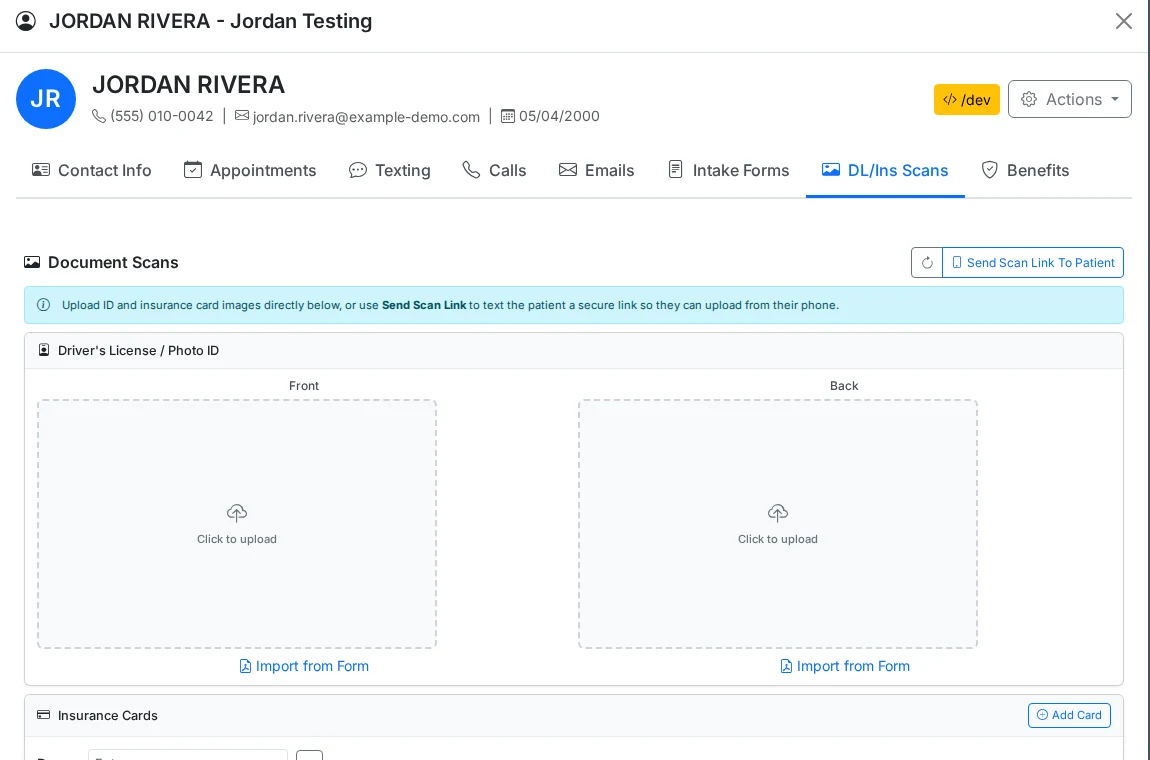
Photograph the front and back of an insurance card or driver's license. Text extraction reads the member ID, group number and payer name, so nobody retypes them. Review the extracted fields, then send them straight into the eligibility form.
-
Check eligibility
A real-time request to the payer returns active coverage, copay, deductible and how much of the deductible is left, plus whether your practice is in network. Results are cached, so a recently checked patient shows a status badge instead of a second lookup.
-
Discover insurance
When a patient has no card, search by name and date of birth. The system queries multiple payers at once and returns the plans it finds. This typically takes 30 seconds to 2 minutes because each payer responds at its own speed.
-
Sort out coordination of benefits
For patients carrying more than one plan, a coordination of benefits check establishes which is primary and which is secondary, so the claim goes out in the right order the first time.
What check-in looks like
Two paths, depending on whether the patient brought their card.
- With a card: open the patient, go to Scans, upload or photograph both sides, click Extract Text, review the fields, then Use for Eligibility to pre-fill the form
- Without a card: open Benefits and Eligibility, click Discover Insurance, enter name and date of birth, and review what comes back
- Either path ends the same way: check eligibility, read the coverage detail, and collect the copay before the visit
- Patients can also upload their own cards. Send a scan link by text; they verify their date of birth and photograph the card on their phone
Questions we get about eligibility
How often should eligibility be checked?
Before each appointment. Coverage changes when patients change jobs, when the plan year resets, or when a payment lapses. Results are cached, so a patient checked recently shows a badge rather than triggering a duplicate lookup.
Does a successful check guarantee payment?
No, and it is worth being clear about this. Eligibility confirms coverage exists. Pre-authorization requirements, medical necessity review and benefit exclusions can still affect whether a claim is paid. Verify procedure-specific requirements with the payer.
What if a payer is not in the list?
An administrator adds it under Settings, Benefits and Eligibility, Payers List. The directory holds 3,433 payers. If it still is not there, that payer may not support electronic eligibility verification at all.
Can patients upload their own insurance cards?
Yes. Send a scan link from the Scans tab and the patient receives a text message. They verify their date of birth, then photograph both sides of the card from their phone. The link expires after 72 hours.
Is patient data secure?
Data moves over encrypted connections and uploaded documents are held in secure cloud storage. Patient upload links require date-of-birth verification and expire after 72 hours. Social security numbers used for a Medicare MBI lookup are discarded immediately after the lookup and never stored.
Why does insurance discovery take longer than a normal check?
Discovery searches many payers at once rather than querying one known plan, and each payer answers at its own pace. It typically completes in 30 seconds to 2 minutes, with results appearing as they arrive.
What is the difference between a copay and coinsurance?
A copay is a fixed dollar amount for a service, such as 25 dollars per office visit. Coinsurance is a percentage of the cost after the deductible is met, such as the patient paying 20 percent while insurance pays 80 percent.
What does deductible remaining actually mean?
It is what the patient still has to pay before insurance starts covering costs at the coinsurance rate. On a 1,000 dollar deductible showing 750 remaining, the patient has already paid 250 this plan year.
What a verified result looks like
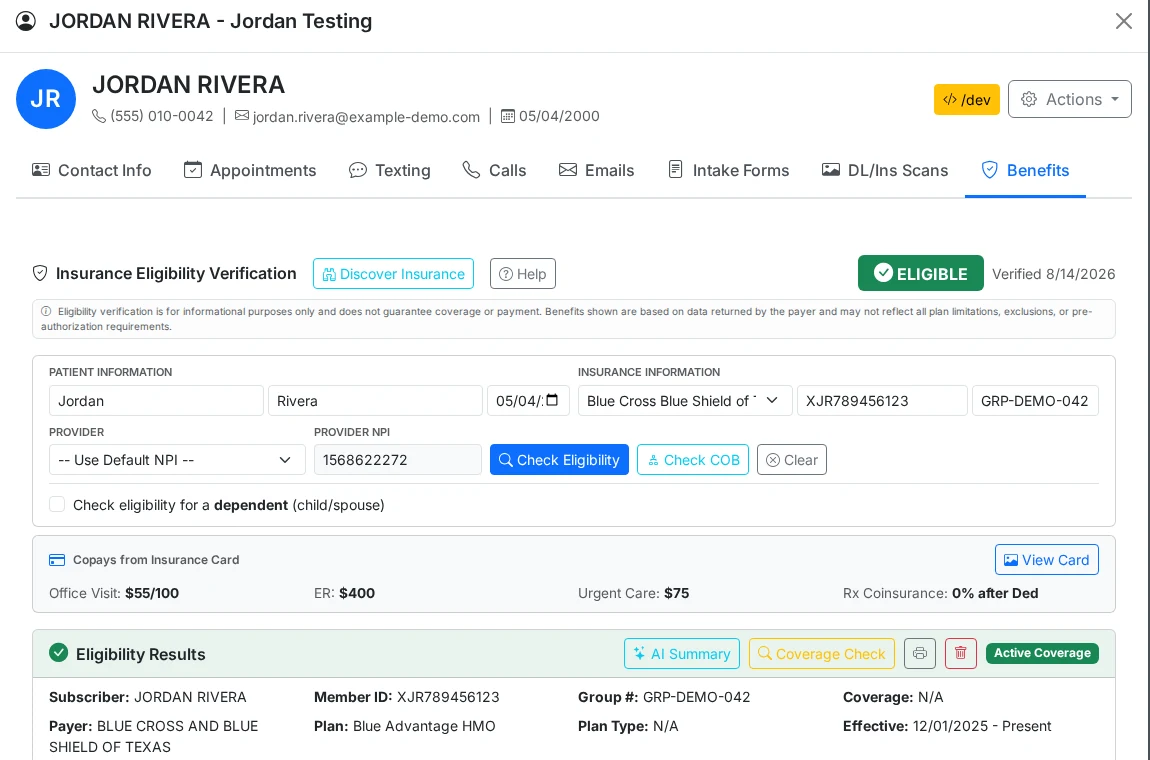
The eligibility panel after a successful check. Copays, member ID, plan and effective dates come back from the payer.
- An ELIGIBLE badge with the date the coverage was last verified
- Copays broken out by visit type: office visit, emergency room, urgent care
- Member ID, group number, payer, plan name and plan type
- Effective dates, so staff can see when coverage started
- Demo account shown; patient details are synthetic
What a verification returns
Active coverage
Whether the plan is active on the date of service, with the payer's own status response.
Copay
The fixed amount the patient owes for the visit, so the front desk can collect it at check-in.
Deductible and remaining
The plan deductible and how much the patient still has to pay before coinsurance applies.
Coinsurance
The percentage the patient pays once the deductible is met, as distinct from a flat copay.
Network status
Whether your practice is in network or out of network for that plan.
Dependents
Coverage can be checked for dependents on the same policy, not only the subscriber.
The payer directory, in numbers
These figures come from the live payer file the product ships with, counted on 2026-08-27.
- 3,433 payers in the directory
- 1,291 of them support real-time eligibility inquiry
- 1,153 of those need no enrollment, so checks work as soon as the payer is switched on
- 138 require enrollment before the first check, which is a one-time setup step
- 597 also support electronic claim status inquiry
- Medicare MBI lookup is available when a patient cannot produce their Medicare number
See it run against your own payer mix
We will check a few of your most common plans live and show you what comes back.
Talk to our team